
What the Calhoun County Probate Court Handles
The county states probate jurisdiction plainly. The Probate Court hears wills, estates, trusts, guardianships, conservatorships, and the treatment of mentally ill and developmentally disabled persons. Small estates and transfer-by-affidavit matters run through the same court. Most of this work moves through forms and hearings rather than long trials, so the record is built from petitions, orders, and reports instead of jury verdicts.
Michigan puts a probate court in each county, except for a few counties that share a consolidated probate district. Calhoun County has its own court, so local estate and guardianship files stay in the county and are not folded into the circuit court. That structure is why probate deserves its own search path.
Michigan runs a layered court system, and the state explains where each trial court fits at the Michigan trial-court overview page. The graphic below shows that hierarchy.
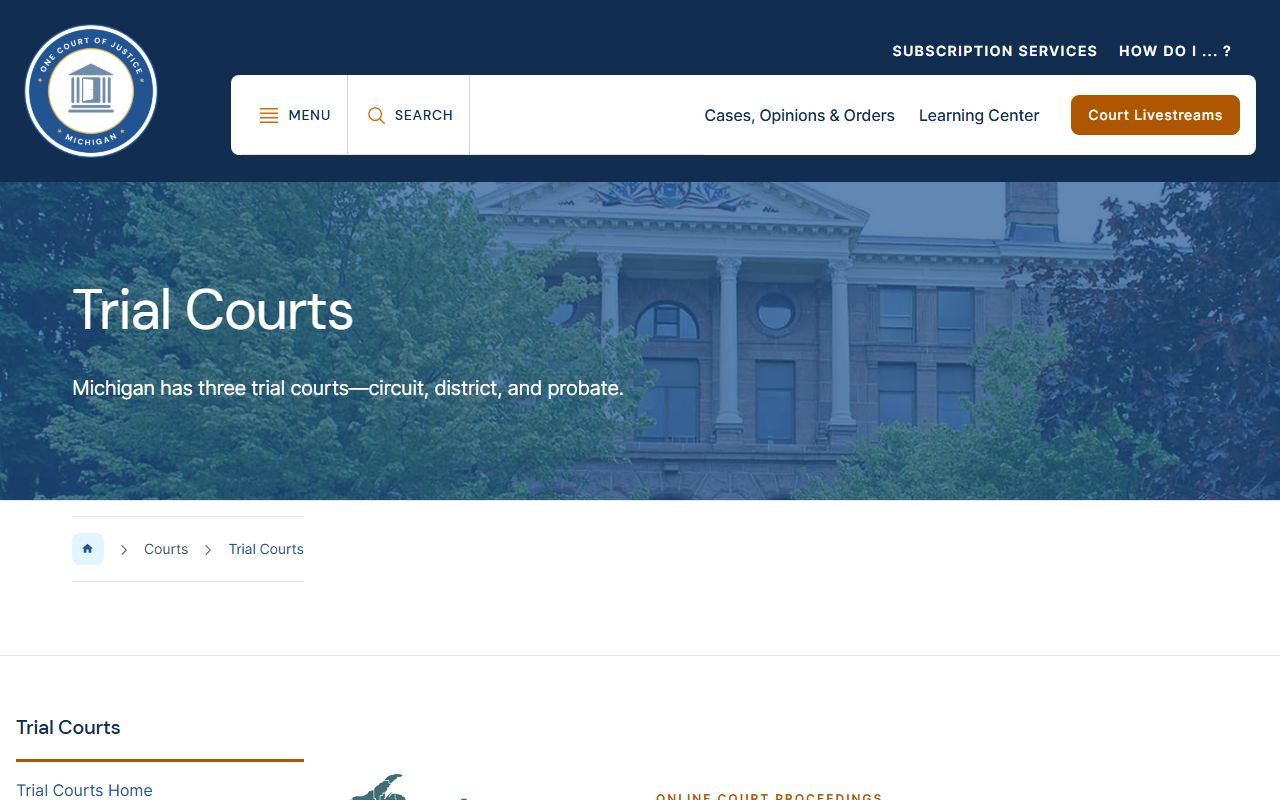
Seeing the Probate Court beside the circuit and district courts helps explain why an estate file will not show up on a criminal or traffic docket. Each Calhoun County court keeps its own records.
Probate Terms Defined
Probate filings lean on a handful of legal words that trip up first-time readers. A quick guide keeps the rest of a Calhoun County estate file readable when the paperwork piles up.
- Testator
- The person who made the will. When that person dies, the will is filed with the Probate Court.
- Executor
- The person named in the will to carry out its terms. Michigan often calls this role the personal representative.
- Intestate
- Dying without a valid will. State law then decides who inherits and in what share.
- Guardianship
- A court order that gives one person authority over the care of a minor or an adult who cannot make safe decisions.
- Conservatorship
- A court order that puts one person in charge of another person's money and property.
- Fiduciary
- Anyone the court trusts to act for someone else, such as an executor, guardian, or conservator, held to a high duty of care.
How to Search Calhoun County Probate Records
The county does not build a separate Calhoun-only estate database. Instead, the Probate Court page links out to case search, forms, filing fees, an inventory fee calculator, court schedules, and guardianship and conservatorship resources. The statewide tool is MiCOURT, and county links route users into the right court there rather than to a county-branded portal.
Start online, then fall back to the clerk when a file is old or not indexed. These steps track the county's own path.
- Open the Calhoun County Probate Court page and pick the case-search or forms link that fits your need.
- Run a name or case-number search on the MiCOURT case-search portal, the state system the county points to.
- Note the case number, the assigned judge, and the next hearing date shown in the result.
- If nothing appears online, call the Probate Court during window hours to confirm the file exists and how to view it.
- For very old estates, ask the court clerk whether the record moved to microfilm or an off-site archive.
Note: The absence of a case in the online search does not prove no file exists, since older estates and limited matters may sit off the public index.
The Calhoun County Probate Court Office
Estate, guardianship, and conservatorship filings all run through one Probate Court office in Battle Creek. The court shares the Michigan Avenue building with other county offices, and its window is open on weekdays. Have a case number ready when you call, because staff can locate a file faster with it.
Calhoun County Probate Court
161 E. Michigan Ave.
Battle Creek, MI 49014-4066
Phone: 269-969-6794
Fax: 269-969-6797
Email: probate@calhouncountymi.gov
Hours: Monday-Friday, 8 a.m. to 4 p.m.
The same office page carries the forms, fee, and schedule links, so it doubles as the hub for anyone opening or tracking a Calhoun County estate.
Calhoun County Probate Filing Fees
The county does not publish a single flat probate-fee table on its public page. Instead it routes filers to an inventory fee calculator and to the forms and fees links, because the inventory fee scales with the value of the estate. Because of that, the safest move is to price a filing through the calculator rather than rely on a fixed number. The table below shows the fee types and how each one is set.
| Fee Type | How It Is Set |
|---|---|
| Estate inventory fee | Set by the inventory fee calculator based on the value of the estate. |
| Petition and filing fees | Listed on the Probate Court forms and fees links for each petition type. |
| Guardianship or conservatorship petition | Charged per the forms and fees schedule on the court page. |
| Certified copies | Charged per page by the court clerk at the counter. |
Running the numbers early matters most for larger estates, where the inventory fee can be the biggest single cost of opening the file.
What a Calhoun County Probate File Includes
A probate file grows as an estate moves from opening to close, so an active case holds more than a will. The documents track who is in charge, what the estate owns, who gets notice, and how assets are finally handed out. A typical open file may include the papers below.
- Petition to open the estate.
- The will and any self-proving affidavit.
- Appointment order naming the personal representative.
- Inventory of the estate's assets.
- Creditor notice and claims.
- Annual or final accountings.
- Distribution orders that close out the shares.
Public access to these court records is framed by the Michigan Court Rules, and access to court files is governed under MCR 8.119 in the Chapter 8 court rules. Those rules tell the clerk what stays open and what can be shielded.
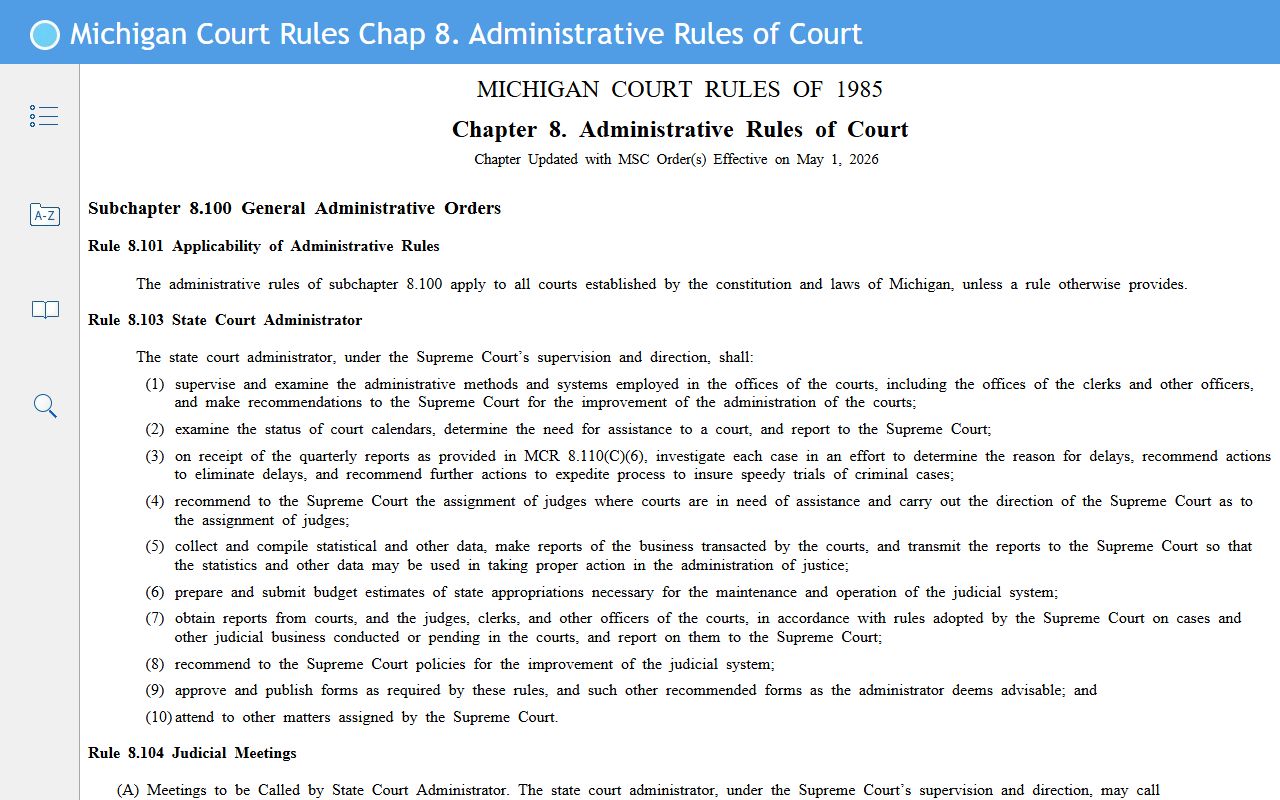
Reading the rule alongside a file explains why some pages are open at the counter while others need a judge's permission or come back redacted.
Opening an Estate in Calhoun County
Opening an estate follows a set order, and the county's probate walk-through mirrors it. Each step points at a tool the court already publishes, so you rarely have to guess where to go next.
- Identify the subject: an estate, a guardianship, a conservatorship, or a mental-health proceeding.
- Use the Probate Court page or the case-search link to check for a current file.
- Use the forms page to pull the correct petition or inventory form.
- File with the probate clerk during window hours or through the county's approved e-filing path.
- Track notices, inventories, and accountings through the case file as the estate proceeds.
Estate matters often overlap with vital records, so the county's marriage and divorce records office can supply the death or marriage certificates a probate filing needs. Gathering those first keeps the estate moving.
Calhoun County Guardianship and Conservatorship Cases
Guardianship and conservatorship files make up a large share of the Probate Court's work. A guardianship covers the care of a minor or an adult who cannot make safe choices, while a conservatorship covers that person's money and property. The court can order one or both, and it reviews them over time.
The Probate Court page carries guardianship and conservatorship resources next to its estate links, which is a signal of how common these cases are locally. Reports and accountings in a conservatorship look a lot like estate accountings, since both track money held for someone else. Access to the underlying papers can be narrower when the protected person is a minor or when health details appear in the file.
Note: Guardianship files that involve a minor often limit access to identifying details, so expect the clerk to ask who you are and why you need the record.
Restricted Calhoun County Probate Matters
Not every probate matter is open to the public. Michigan treats the mentally ill and developmentally disabled through the Probate Court, and that means the clerk's index and the public docket are not the same thing. The public can often learn that a matter exists, but the underlying papers may be limited depending on the exact proceeding.
Important: Mental-health commitment files carry the tightest limits in probate, so plan on a narrow public view and expect sensitive health content to stay sealed.
Juvenile matters follow the same instinct toward privacy across Michigan courts. The state keeps juvenile records confidential under statute, and the rule is set out at MCL 712A.28. The statute page below spells out how that confidentiality works.
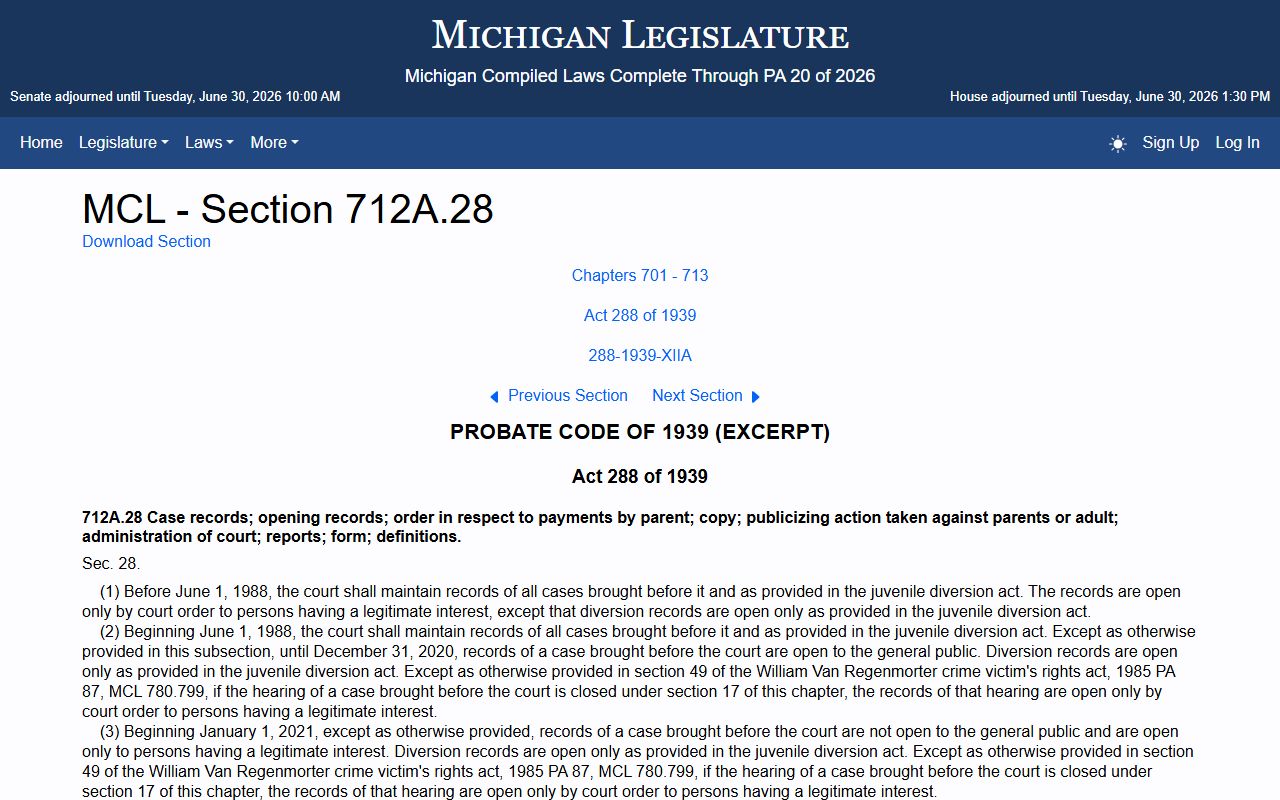
Guardianships of minors and family matters sit near that same confidentiality line, so a probate search on those subjects often returns less than an ordinary estate search.
Older Calhoun County Probate and Estate Files
Old files are where the online search runs out. When a probate matter is not in the case search, the county's clerk offices become the fallback. The clerk can pull records that never made it into the digital index and can tell you whether a file has moved to microfilm or an off-site archive.
The clerk's court-file rules give a sense of how far back the digital and paper trails reach. Newer cases can be located in person or by email when you supply a case number and the known parties, and a name search without a case number carries a small per-name fee. Older files sit on microfilm with an archival lookup fee, and the very oldest materials have moved out of the office entirely to a regional legacy collection. Copies are charged by the page, and certification adds a set fee.
Because the same office network handles court files and copy requests, the Calhoun County Clerk of Court is the right first call for anything the Probate Court case search will not show. Bring names, approximate dates, and any case number you already have.
Note: A clerk file search covers court records only and is not a criminal-history background check, so treat the two as separate requests.