
Criminal Court Records in Calhoun County
A criminal court record is the case file a court opens the moment charges are filed. It is not a single sheet. It holds the charging paper, the notices, the plea, every order, and the final judgment. The clerk of court keeps this file and builds it out entry by entry as the case moves. In Calhoun County, the criminal division of the clerk's office maintains the felony files at the courthouse, while the district court holds its own misdemeanor and traffic files. The record is the official story of what the court did, not what the police first suspected.
Two trial courts hear criminal cases in the county. The 10th District Court takes all misdemeanor charges, along with the early steps of a felony: the complaint, the arraignment, and the preliminary exam. If a judge finds enough proof at that exam, the felony binds over to the 37th Circuit Court, which then holds the trial, plea, and sentence. So a serious case can leave a trail in both courts. The lighter case, such as a first-time misdemeanor, tends to open and close in the district court alone.
How to Search Calhoun County Criminal Court Records
The county does not run its own case database. Instead, the district and circuit court pages route the public to MiCOURT, the statewide case-search tool. It is the same portal for both court levels, but the links from the county filter you to the right Calhoun courts. Have the case number ready if you can, since a name search can pull back many people with the same name.
- Open the MiCOURT case-search portal from the district or circuit court page.
- Search by the defendant's name, or paste the case number for a direct hit.
- Narrow the results by court, case type, and filing date.
- Open the case to read the docket, the charges, and the disposition.
- Ask the clerk for a certified copy if you need the file for a legal use.
Older files may not be online at all. The circuit clerk can locate cases back to 1984 and sell copies in person or by email when you give the case number and the parties. If you do not know the case number, a name search runs five dollars per name. Copies cost one dollar per page, and a certified final judgment adds a ten-dollar certification fee. The county posts a separate page for paying district criminal-case costs online, shown in the county's district criminal-case payment portal.
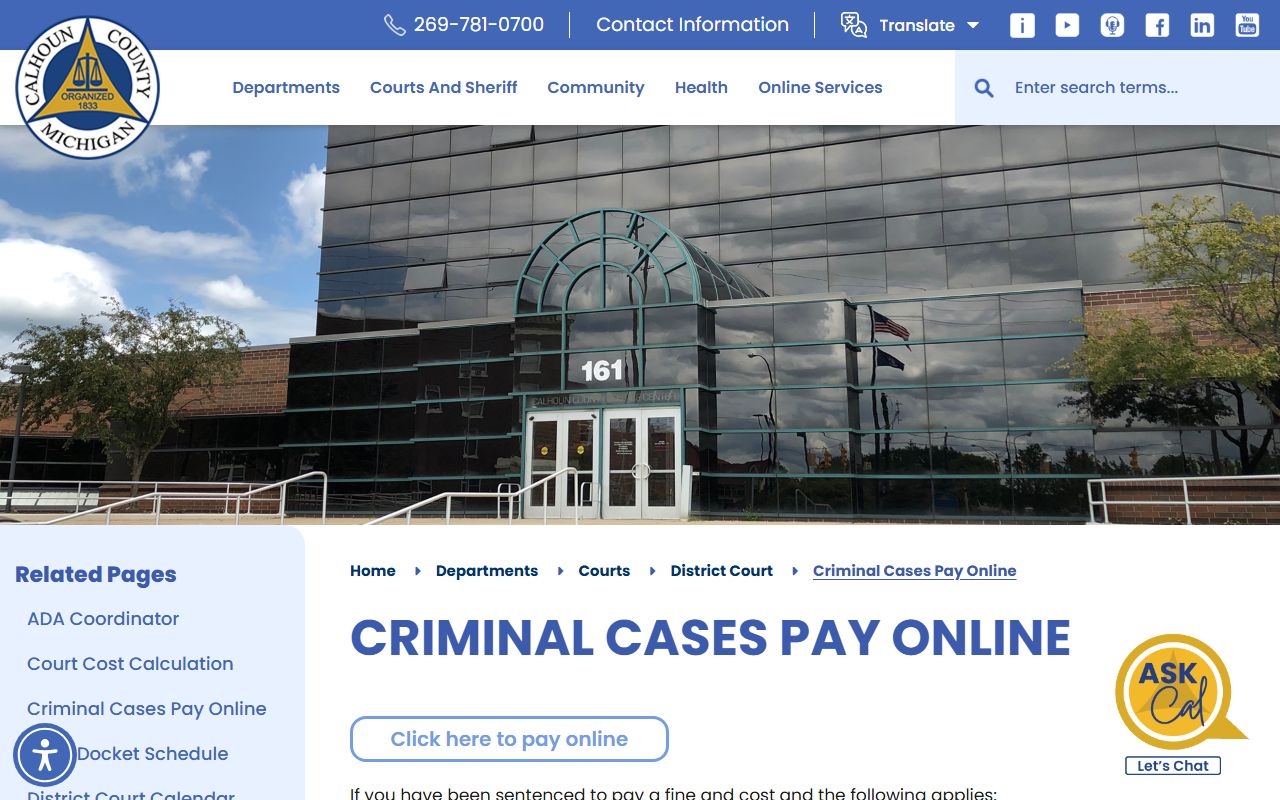
That payment page ties a case number to any fines, costs, or restitution the court has ordered, which is often the money side of the same criminal record you are trying to read. For the charges themselves, and how they change from filing to conviction, the county's arrest records and court charges page breaks the charging side down in more detail.
Stages of a Criminal Case in Calhoun County
A criminal case moves through set steps, and each step leaves a mark in the record. The docket reads almost like a timeline, so once you know the stages you can tell where a case stands at a glance. A felony and a misdemeanor share most of the same beats, but the felony adds a preliminary exam and a bindover before the circuit court takes over.
Case flow: Charges Filed › Arraignment › Preliminary Exam / Pretrial › Plea or Trial › Disposition › Sentencing
| Stage | What Happens |
|---|---|
| Arraignment | The court reads the charge, the defendant enters a first plea, and the judge or magistrate sets bond and release terms. |
| Preliminary Exam / Pretrial | In a felony, the district court weighs whether there is enough proof to bind the case over. Pretrial hearings and motions sort out evidence and possible plea deals. |
| Plea or Trial | The defendant pleads, or the case goes to a judge or jury who returns a verdict. |
| Sentencing | After a plea or guilty verdict, the court sets the sentence: jail, prison, probation, fines, or a mix of terms. |
The county's public defender publishes a plain-language guide to how felony and misdemeanor cases move, seen on the office's felony and misdemeanor case-process page. It walks a defendant through each court date and what to expect. That guide is a useful companion to the docket, because it names the same stages you see in the file.
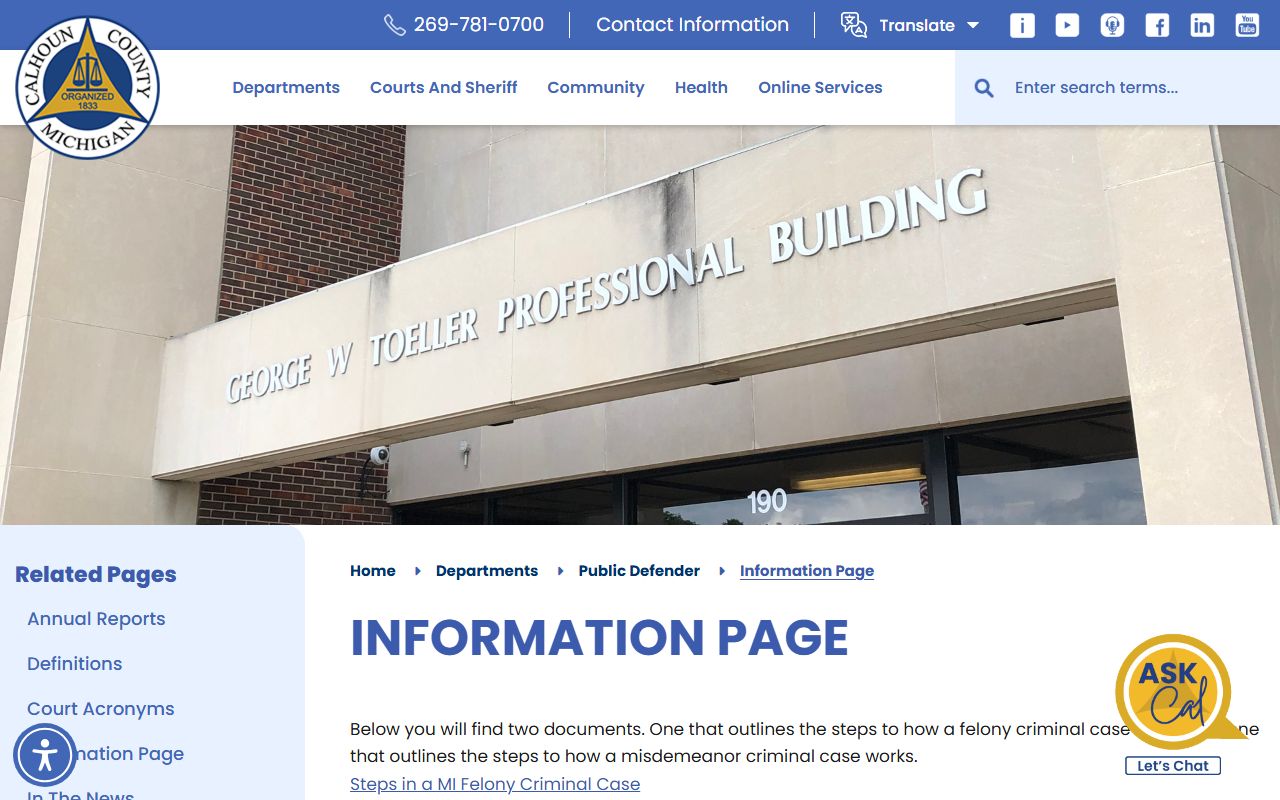
Reading that walkthrough beside the docket makes each Calhoun County criminal court record easier to follow from first appearance through sentencing.
Note: A felony case can appear in both district and circuit court records, since the early stages are held in district court before the case binds over to the circuit court.
What a Calhoun County Criminal Court Record Shows
A Michigan court record is defined broadly. It can hold pleadings, orders, judgments, case-management entries, notices, and the process the court issues. The public case-search view shows a slice of that file, not always the full paper stack. The fields below are the ones you will most often see, and they are the same fields the county's daily dockets display.
| Field | What It Shows |
|---|---|
| Case Number | The court's file ID. A format like 2026-0000072180-DC carries a year prefix and a court-type suffix. |
| Defendant | The person charged, listed by legal name. |
| Charges | Each count as filed, with the statute cited and the severity level noted. |
| Plea | How the defendant answered each charge: guilty, not guilty, or no contest. |
| Disposition | The outcome of each count: convicted, dismissed, acquitted, or bound over. |
| Sentence | The terms the court imposed, such as jail, probation, fines, costs, or restitution. |
You may also see the judge or magistrate, the hearing dates and courtroom, the case status, and any balance due. What you will not see is protected data. Social Security numbers, financial-account numbers, and the names of minors are kept out of the public view even when the rest of the file is open.
Note: Public case files hide protected data such as Social Security numbers, financial-account numbers, and the names of minors, even when the rest of the file stays open.
Charges vs. Convictions
A charge is not a conviction. A charge is only an accusation, filed on probable cause, and it can be dropped, reduced, dismissed, or beaten at trial. A conviction is the finding of guilt itself, reached by a plea or by a verdict, and it requires proof beyond a reasonable doubt. A single criminal court record can hold both: three counts charged, two dismissed, one convicted. Reading the disposition on each count is the only way to know which is which.
| Charge | Conviction | |
|---|---|---|
| Stage | Accusation | Verdict or plea |
| Burden of Proof | Probable cause | Beyond reasonable doubt |
| Can It Be Dropped? | Yes, before trial | Only through appeal or set-aside |
| Public Record | Yes | Yes |
This split matters most in background questions. A file that lists a felony charge tells you the state once accused the person of that crime. It does not tell you the person was found guilty. Always trace each count to its disposition before you draw any conclusion from a name in the record.
Reading Dispositions and Sentences
The disposition is the final outcome the court entered on a charge. A handful of terms cover most cases, and each one means something distinct. Learning them turns a wall of docket text into a clear result you can trust.
- Guilty
- The defendant admitted the charge or a jury found it proven.
- Not guilty
- A verdict of acquittal; the charge did not stick.
- Dismissed
- The court ended the count without a conviction, with or without prejudice.
- No contest
- The defendant did not fight the charge, and it is treated as a conviction for sentencing.
- Bound over
- A felony passed the preliminary exam and moved up to the circuit court.
The sentence follows the disposition. It may set a jail or prison term, a probation period, fines, court costs, and restitution to a victim. Michigan judges often blend these, so a single line can order both probation and a fine. When the record shows probation or restitution, the case usually stays open on the court's books until the terms are met and the balance is paid.
Note: A dismissal or acquittal still leaves a public case entry, so a name found in the record does not always mean a conviction followed.
The Prosecutor's Role in Calhoun County Criminal Cases
The prosecutor decides what charges get filed, and that choice shapes the whole criminal court record. David E. Gilbert is the county's elected prosecuting attorney, and the office is independent of the Michigan Attorney General. The office reviews police reports, files the complaint that opens a case, and carries the charge through plea talks, trial, and sentencing. When you read who is pursuing the counts in a file, that is this office at work.
The prosecutor's public page lists the office contacts, its staff, and its resource links, as shown in the county's prosecuting attorney office page. It is the first stop for questions about a pending charge or a victim's rights in a live case.

The office does more than file felonies and misdemeanors. It runs victim services, handles restitution, sits on the concealed weapon permit board, and runs diversion work such as bad-check recovery. Its structure and duties are laid out on the county's prosecutor office structure page.
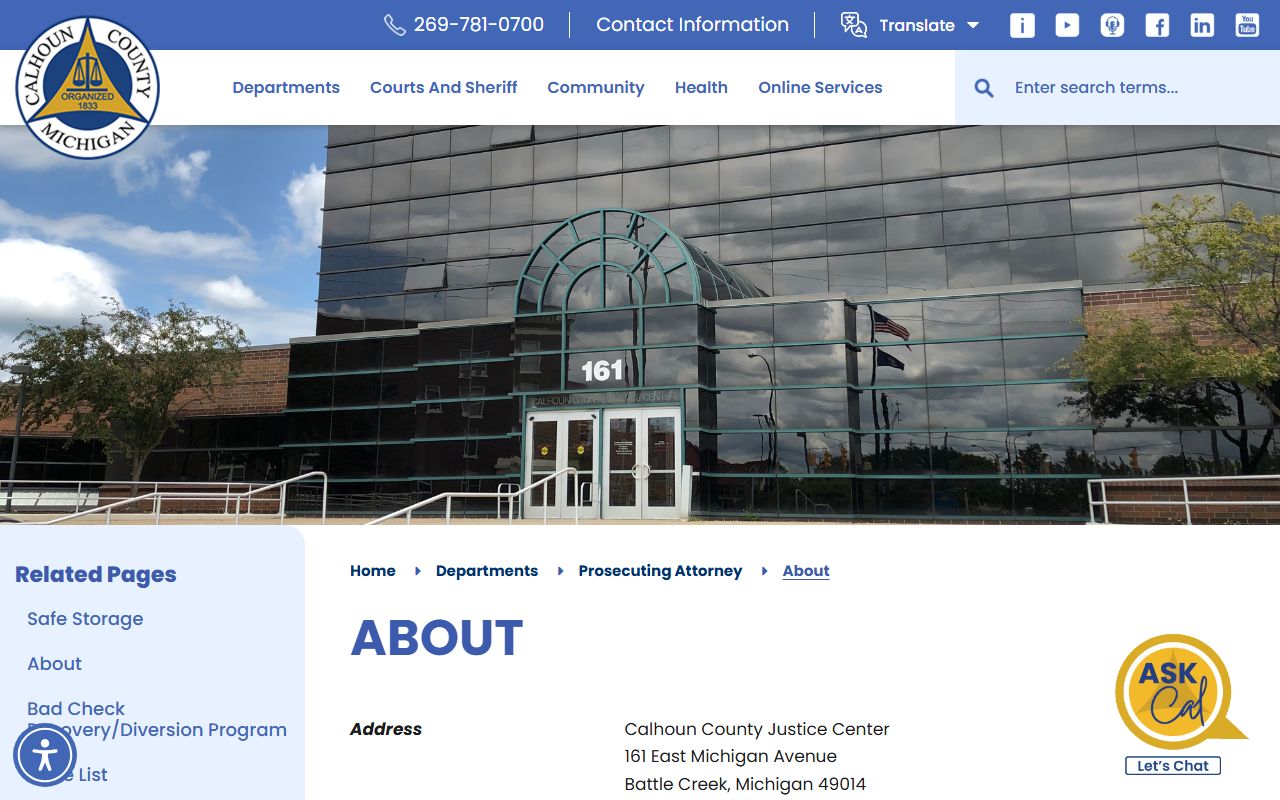
Understanding the charging role helps you read a record honestly. A count can be amended or dropped by the prosecutor at any point before judgment, and the docket will show that change. What began as a felony may end as a misdemeanor plea. The record captures the final charge, not just the first one.
Defense Counsel in Calhoun County Criminal Cases
Every criminal record has two sides, and the defense is the other one. When a person cannot afford a lawyer for a felony charge, the county's public defender office provides appointed counsel. The client does not pick the assigned attorney. The office contact block and its role are set out on the county's public defender office page.
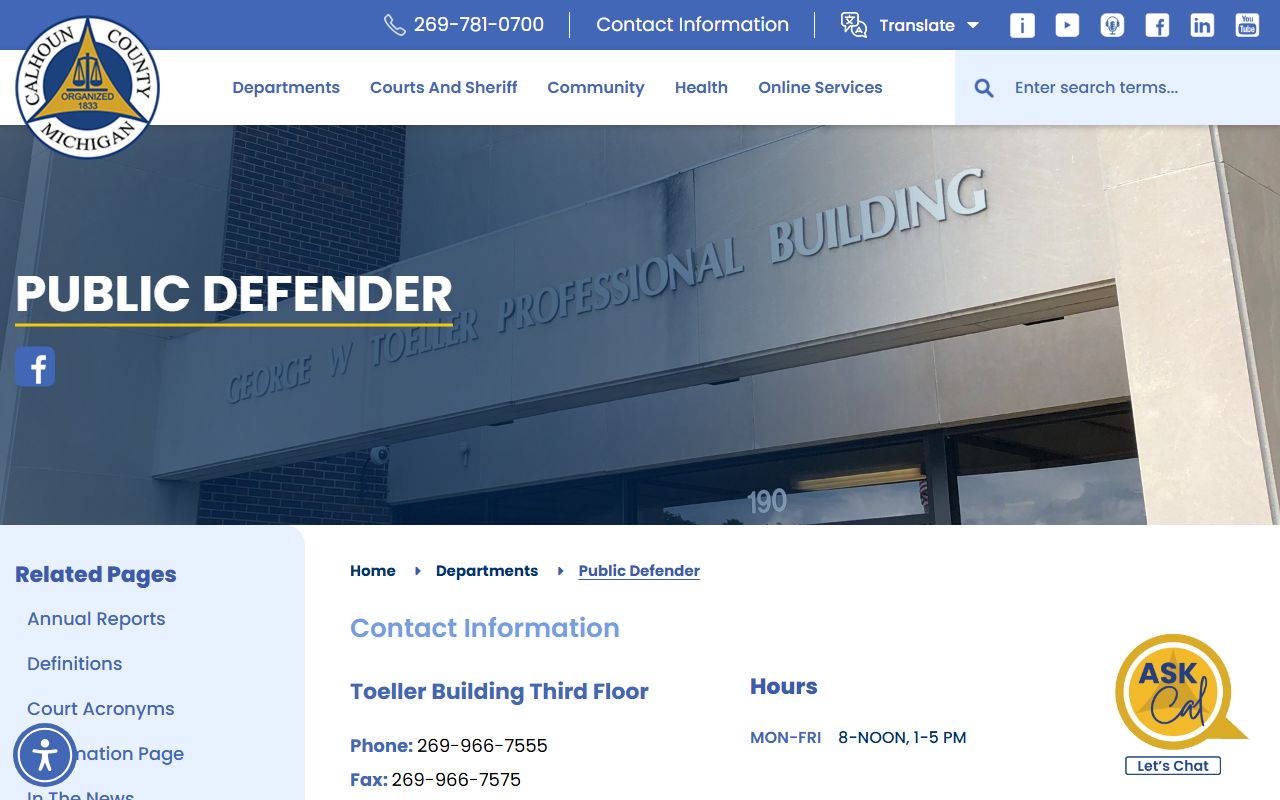
The defense attorney's filings show up in the case record too: motions, notices, and the plea the client enters. So the file is a two-sided account. It records what the state charged and what the defense answered, which is why a full read of the docket, not just the charge line, gives the fairest picture of a case.
Sealed vs. Expunged Criminal Records
People often mix up sealed and expunged records, but they are not the same. A sealed record still exists; it is just hidden from public view by a court order, and some agencies keep limited access. An expunged, or set-aside, conviction is treated as though it never happened for most public purposes. Michigan handles set-asides through a petition process, and its Clean Slate reforms widened who qualifies.
| Sealed | Expunged | |
|---|---|---|
| Visibility | Hidden from public | Treated as if it never existed |
| Law Enforcement | Limited access | Very limited access |
| Eligibility | By court order in defined cases | Set-aside petition under Michigan law |
The petition process and the effect of a set-aside are spelled out in statute. MCL 780.621 lets eligible convictions be set aside through a petition, and MCL 780.623 explains how a set-aside conviction is treated afterward and why it drops from public view. To confirm whether a conviction has actually been set aside, the county's circuit court clerk page points to three checks: a Michigan State Police personal records check with fingerprints for thirty dollars, an ICHAT name search for ten dollars, or a check with the court of conviction.
Public Access to Calhoun County Criminal Court Records
Criminal case files are public by default in Michigan. Court records fall under the court-access rules, and county-office records fall under the Freedom of Information Act. The two frameworks overlap, but the rule of thumb is simple: use the court for a case file, and use FOIA for other agency records. Hearings are public as well, though the county notes that courts may not broadcast every hearing online, so a visit or a docket check is sometimes needed. For the wider set of civil and family files, the county's court records overview covers the same access rules.
Key Statutes:
Michigan Code § 15.231 - Michigan's FOIA begins with a presumption that public records are open unless an exemption applies.
Michigan Code § 712A.28 - juvenile case records are kept confidential and are not generally public.
Background Checks and Criminal Record Lookups
A courthouse file search is not a background check. The county is clear on this point: an in-person civil or criminal search at the clerk covers Calhoun County felony records only, and it is not a statewide criminal-history check. For a true background report, a fingerprint-based Michigan State Police check or an ICHAT name search pulls the statewide history. Employers and landlords who need a regulated report must use a screening company that follows federal rules.
Important: This site is not a consumer reporting agency under the Fair Credit Reporting Act, and its records may not be used for credit, employment, tenant, or insurance screening.
Restricted Calhoun County Criminal Court Records
Some criminal matters stay out of public view even when the courthouse is open. Juvenile cases are the clearest example. The clerk's office says all juvenile matters are nonpublic, and staff will ask for identification before they discuss or release any document. The public dockets leave delinquency and child-protective cases off the schedule entirely.
Other files are limited too. Sealed cases stay closed until a judge unseals them. Set-aside convictions drop from the ordinary public record. Divorce complaints are restricted until proof of service is filed, and mental-health proceedings in probate carry their own limits. Personal identifiers are redacted across the board. Someone charged, then cleared, may also ask the court to seal or set aside the file so it no longer surfaces in a routine search. If you cannot find a case you expect to exist, one of these limits, rather than a search error, is often the reason.
Note: The absence of a case on a public schedule is not proof it does not exist, since juvenile and sealed matters are kept off the public view by law.