
How to Search Calhoun County Court Records
The county's search path is a stack, not a single box. Michigan runs a statewide public case-search system called MiCOURT, and the county court pages route users into it rather than build a separate Calhoun-only database. That means the platform is statewide in design but county-specific in what you see, because the landing links filter down to the local courts. Current circuit, district, and probate matters all live in the same system. For payable items like traffic tickets, the state also runs an ePAY tool that handles lookup and payment in one place.
Before you start, gather the party's full name and, if you have it, the case number. A case number is the fastest route because it lands you on the exact file. The county court pages make a point of telling callers to have that number ready. The lead-in image below shows the state case-search screen where most Calhoun County searches begin.
You can view the live statewide tool at the MiCOURT case search portal, which is the starting point for current trial-court matters.
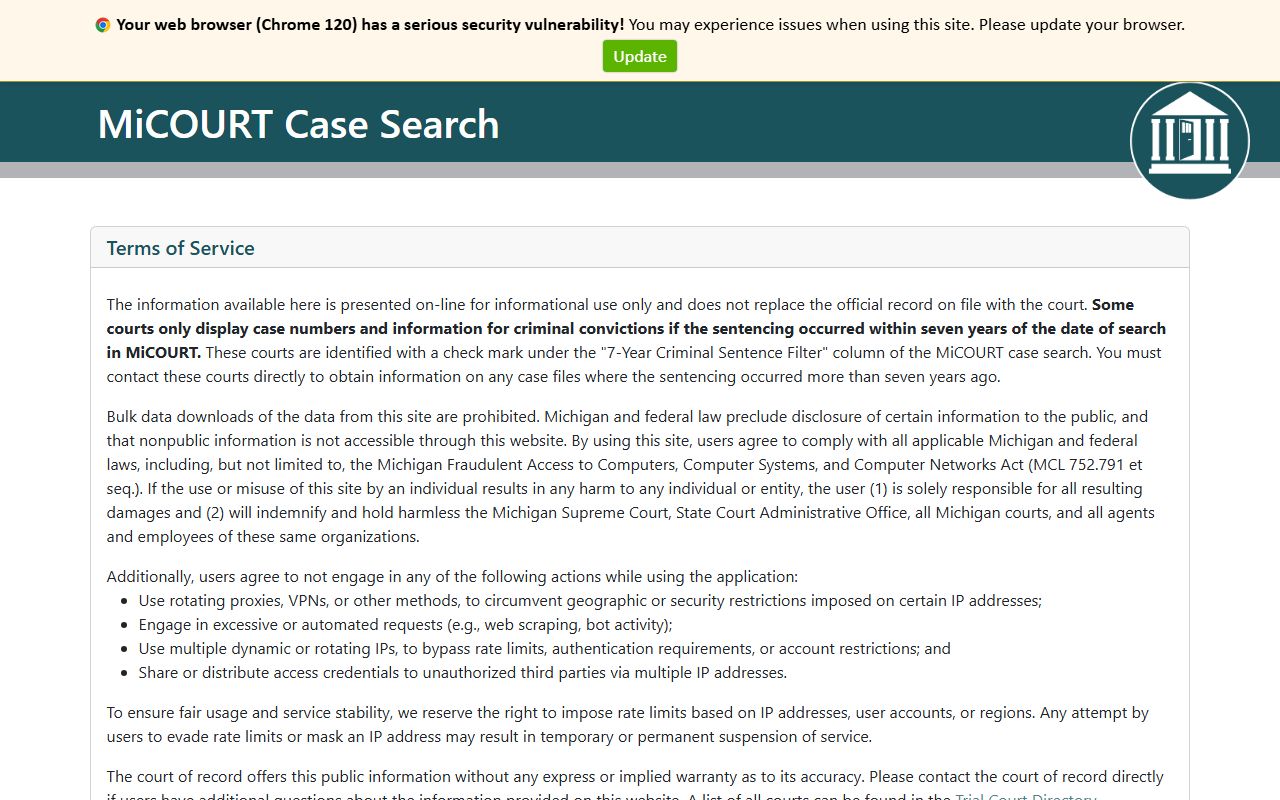
The screen confirms that the search is name or case-number driven, and that the county's links simply point you at the right court code. Follow these steps to move through a search from start to finish.
- Decide which court holds the file: circuit for felonies and larger civil suits, district for misdemeanors and traffic, probate for estates and guardianships.
- Open MiCOURT case search and choose the search-by-name or search-by-case-number path.
- Enter the party name or the case number, then add a date filter if the name is common.
- Review the result list, confirm the court level, and open the matching case to read its docket history.
- For a traffic or payable item, switch to the state ePAY tool, or call the clerk when the file is older or not listed online.
If a case does not appear online, that does not mean it never existed. Juvenile matters stay off the public view, older files may sit on microfilm, and the clerk still owns the underlying paper. Daily hearing times and courtroom assignments show up on the county docket pages, which sit beside the case search rather than inside it. Those hearing lists are summarized on the Calhoun County court dockets page.
Calhoun County Court Records Search Fields
Each portal exposes a slightly different set of fields, and knowing them up front keeps a search from stalling. MiCOURT is the general case-lookup tool. It is heavy on scripting, so the visible form is simple: you pick a court, then search by name or case number and narrow with dates. The table below lists the fields the public sees when using the statewide case search.
| Field Label | Type | Required | Notes / Format |
|---|---|---|---|
| Search by court | Tab / selector | Yes | County links point to the correct court code. |
| Search by name | Text | Yes in public use | Name-based search path. |
| Case number | Text | Optional | Used for direct case lookup. |
| Date filters | Date fields | Optional | Used to narrow older records. |
The state ePAY portal is a separate tool built for traffic and other payable court items. It is the most transparent public field set the county and state expose, and it supports several search modes at once. You select the county and court first, then use a name, ticket number, date of birth, driver license, or plate to find the citation. The fields are shown below.
| Field Label | Type | Required | Notes / Format |
|---|---|---|---|
| County | Dropdown | Yes | Select Calhoun County first. |
| Court | Dropdown | Yes | Choose the matching court before searching. |
| Last Name | Text | Yes | Used in name-based searches. |
| Ticket / Case # | Text | Yes for one mode | Ticket or case number. |
| Date of Birth | Date | Yes for DOB mode | Month, day, year. |
| Driver Lic # | Text | Yes for license search | Paired with a state selector. |
| License Plate # | Text | Yes for plate search | Paired with a state selector. |
You can reach the payable-item tool through the Michigan ePAY ticket search. The portal tells users to contact the court directly when a ticket is not listed, which marks the edge of its coverage.
Types of Calhoun County Court Records
The record system splits by court and by subject. The circuit clerk keeps felony, civil, domestic, family, and personal-protection files. The district court holds traffic, civil-infraction, misdemeanor, and small-dollar civil files. Probate keeps estates, guardianships, conservatorships, and mental-health matters. The clerk's vital-records counter handles marriage licenses and certified copies, while the sheriff's office keeps custody and booking records. The courts landing page ties these offices together under one Justice Center roof.
You can see how the county organizes those offices on the Calhoun County courts landing page, which lists each court and its contact block.
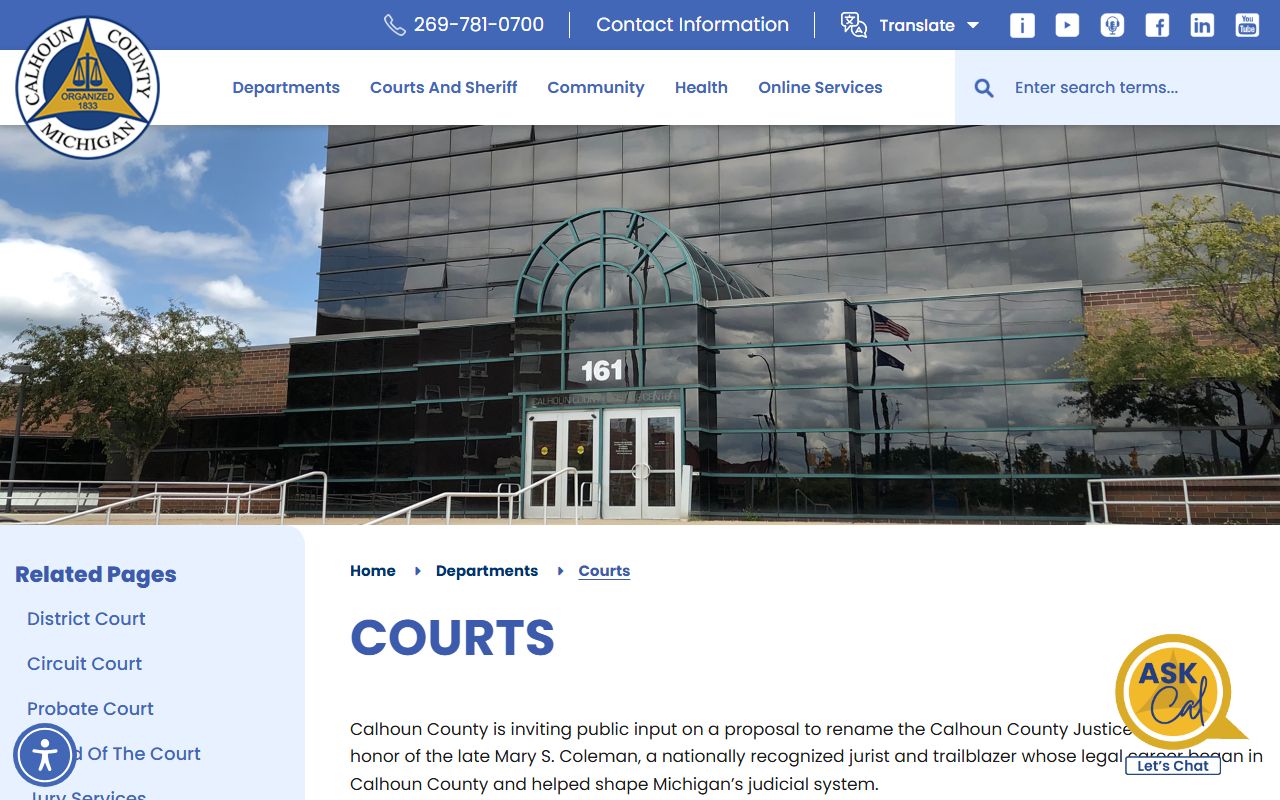
That page confirms the courts share a single downtown complex, even though each one owns its own set of files. The most common public record types break down like this.
- Civil suits, judgments, and orders, split by dollar amount between circuit and district court.
- Criminal files, with felonies in circuit court and misdemeanors in district court.
- Family matters such as divorce, custody, support, and personal protection orders.
- Probate files covering wills, estates, guardianships, and conservatorships.
- Traffic and civil-infraction tickets tracked through the district court and the state ePAY tool.
Juvenile delinquency, neglect, and abuse cases also exist, but they are nonpublic and do not appear on the public schedules. Traffic files often begin on a payment page rather than a classic docket, so the traffic path works a little differently from the rest. That pathway is covered in more depth on the Calhoun County traffic court records page.
Calhoun County Court Records by Court Level
Three trial courts serve the county, and each one produces a distinct slice of the record set. The 37th Circuit Court is the main general-jurisdiction court. It handles felony cases after they move out of district court, civil lawsuits, family and domestic matters, adoptions, name changes, personal protection orders, and appeals from lower bodies. Older civil files, family matters, and full felony files live in the circuit clerk's office.
The county describes the court and its resources on the 37th Circuit Court page, which links to dockets, fees, and judge biographies.
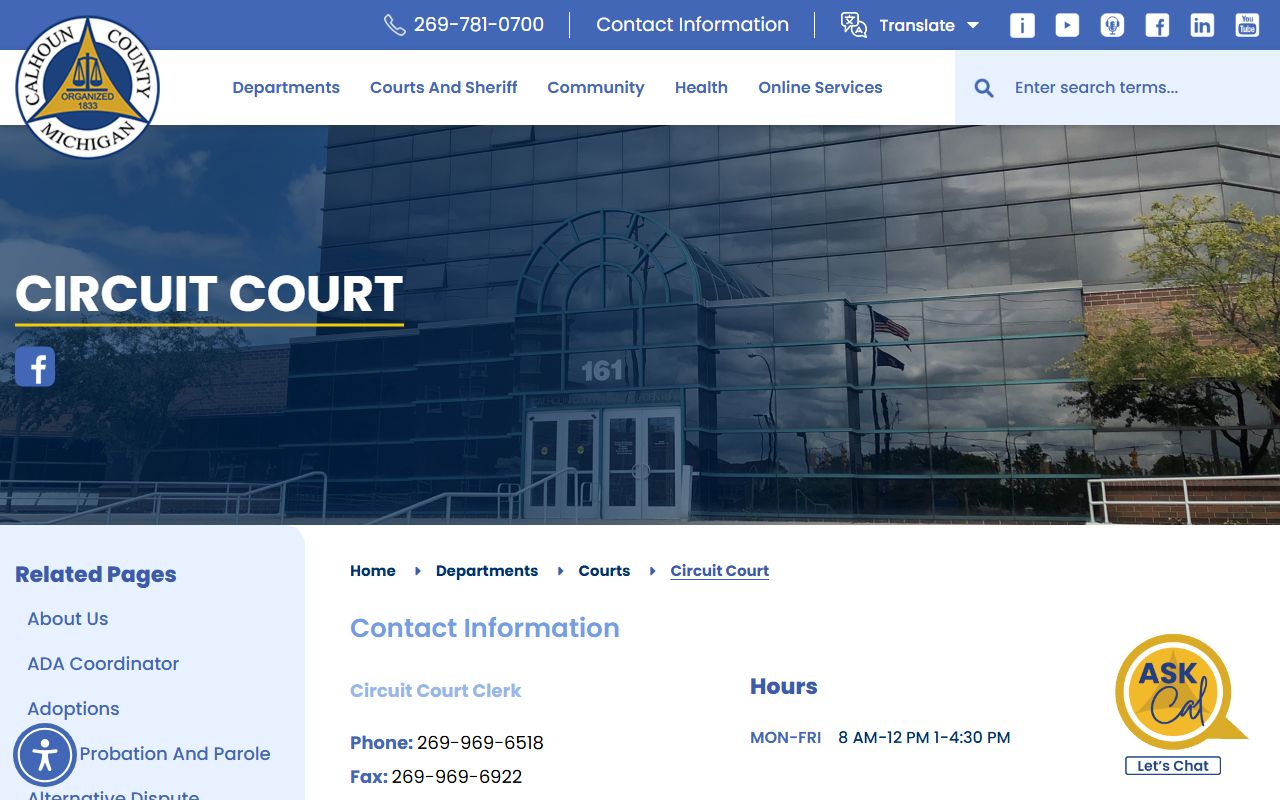
That page shows why circuit files matter for anyone tracing a serious criminal case or a large civil dispute. The 10th District Court is the lower trial court, and it is the one most residents touch first. It handles misdemeanors, civil infractions and tickets, landlord-tenant matters, small claims, and civil cases under $25,000. It also runs warrants, arraignments, and preliminary examinations, so a felony often shows its earliest steps here before bindover to circuit court.
The county lays out those duties on the 10th District Court page, which posts hours and a resource list.
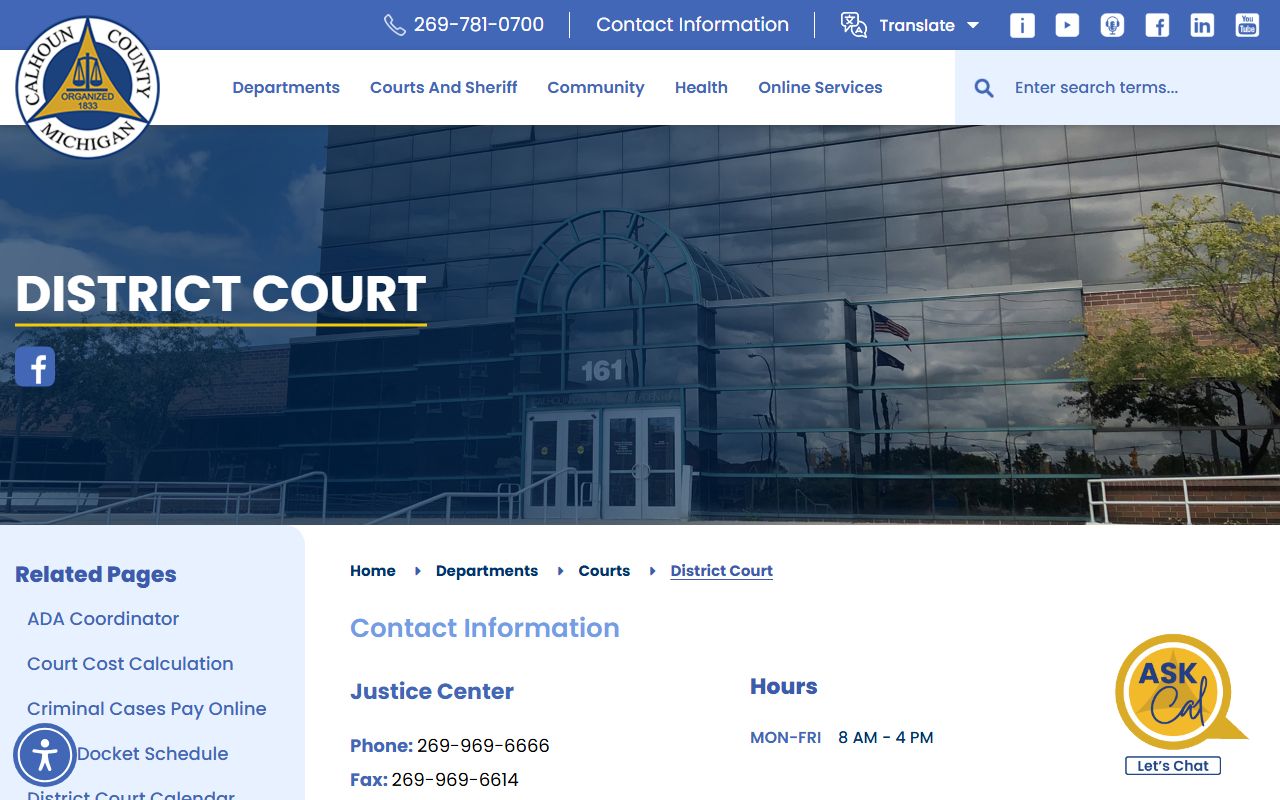
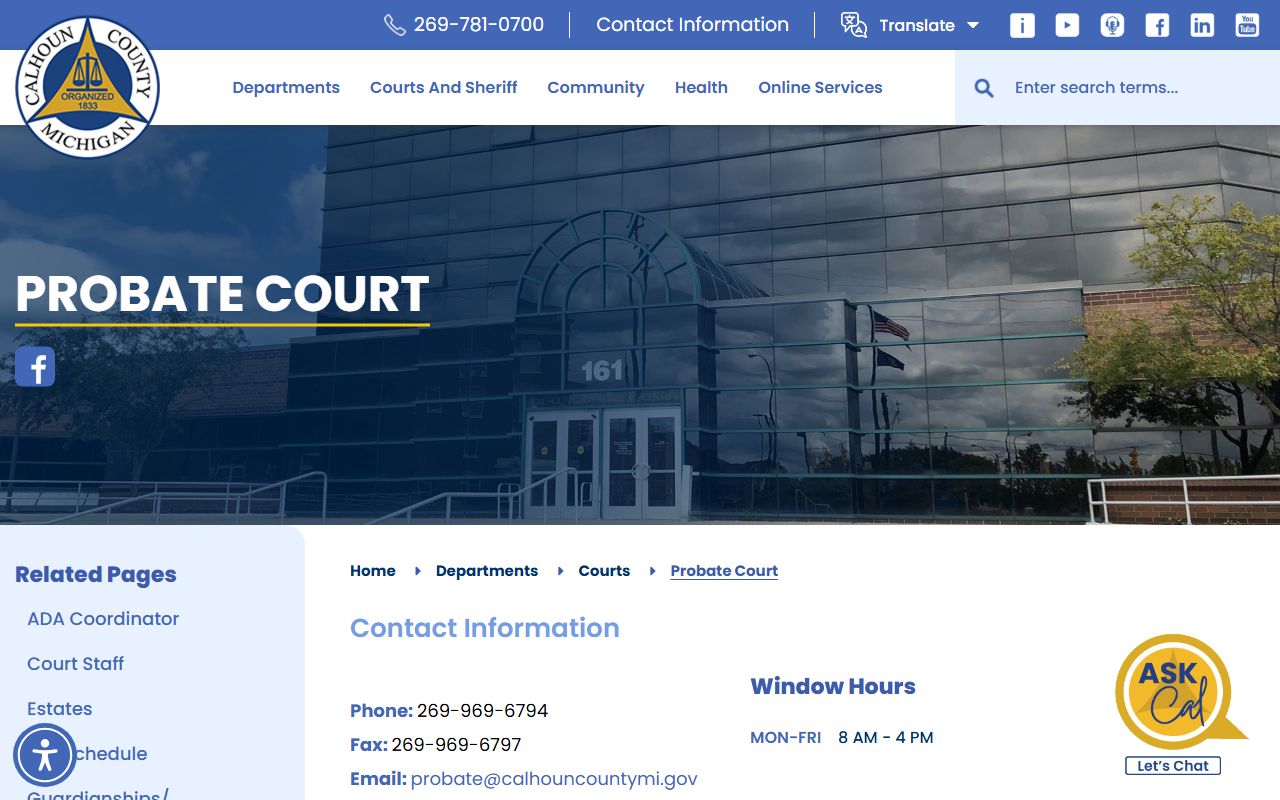
District files answer the common question of where a fresh criminal or traffic case sits. Probate is a separate trial court, not a circuit division. It holds wills, estates, trusts, guardianships, conservatorships, and the treatment of mentally ill and developmentally disabled persons. Its files often move through forms rather than long litigation, and the county pushes users toward a case search and a fee calculator.
The Calhoun County Probate Court page gathers those forms, the fee tools, and the case-search link in one place.
Probate files usually include the petition, appointment orders, inventories, notices, and final accounting papers when the file is open. Appeals from all three courts go up to the Michigan Court of Appeals, Fourth District.
What Calhoun County Court Records Show
Michigan defines a court record broadly. It is not a single PDF. A file can hold pleadings, orders, judgments, case-management entries, notices, and process issued by the court. That is why the daily dockets and case-search tools show only a slice of the file, not the full paper stack. The fields below reflect what the public systems actually surface, drawn from the county's own docket and search displays.
| Field | What It Shows |
|---|---|
| Case Number | The file identifier, formatted with a year prefix and a court-type suffix, such as 2026-0000072180-DC. |
| Party Name | The plaintiff, defendant, petitioner, or respondent tied to the case. |
| Filing Date | When the case was opened with the court. |
| Case Type | Civil, criminal, family, traffic, or probate classification. |
| Court Level | Circuit, district, or probate court. |
| Judge or Referee | The judicial officer, magistrate, or referee assigned to hear the matter. |
| Hearing Date and Location | The scheduled time and the assigned courtroom. |
| Disposition | The status or final outcome of the case. |
| Balance Due | Any payment or amount owed on the file. |
The ePAY result view adds a traffic-specific angle. It surfaces the ticket number, name, license plate and state, issue date, the violation text, and the amount due. That is a good example of what many people really want from a traffic record: the citation identity, the charge, and the money owed. Protected data does not appear in the public view. Social Security numbers, financial-account numbers, and the names of minors are kept out of the record the public can read.
Note: The absence of a case from a public schedule is not proof it does not exist, because juvenile and other restricted matters are removed from the public view.
Public Access to Calhoun County Court Records
Michigan gives readers three access routes: the Freedom of Information Act for county-office records, court rules for court files, and a few targeted confidentiality statutes for juvenile and expunged records. The state FOIA statute at MCL 15.231 starts with a presumption of access unless an exemption applies, and it sets the tone for how county offices release material. Court files, though, follow their own access framework rather than FOIA alone.
Court records are governed mainly by the Michigan Court Rules. The public-access rule known as MCR 8.119 in Chapter 8 spells out how a court keeps and shares its files. The state court system also publishes a practical guide to how trial courts manage and release records. That guidance explains what stays open, what gets redacted, and how a clerk logs each file.
You can review the state's public-access overview on the Michigan courts records-management page, which frames how trial courts handle public files.
That page confirms the split most people miss: circuit files go through the circuit clerk, district files through the district court, probate files through probate, and county-office material through FOIA. A courthouse file search is not a criminal-history background check, and the clerk will say so plainly. When you request a copy, expect a per-page fee and, for certified documents, a certification charge on top.
Sealed and Confidential Calhoun County Records
Several categories stay closed to the public, and the county pages are unusually clear about them. Juvenile cases are the plainest example. The circuit clerk treats all juvenile matters as nonpublic and asks for identification before discussing or releasing any document. The juvenile confidentiality statute at MCL 712A.28 keeps those case records out of general public view. Delinquency and child-protective matters also stay off the public dockets.
Other restrictions follow the same logic. A divorce complaint is not open for public viewing until proof of service is on file, under MCL 552.6a. Sealed cases stay hidden until a judge unseals them, and mental-health proceedings in probate are limited-access matters. To view a sealed file, a person generally must ask the court that sealed it and show a legal reason the judge will accept.
Expungement is the most common practical question. Michigan's Clean Slate framework, built on the set-aside statute at MCL 780.621, lets eligible convictions be set aside through a petition. The circuit clerk points readers to three ways to check whether a conviction has been set aside.
- Order a Michigan State Police personal records check with fingerprints for a $30 fee.
- Run an ICHAT name search for a $10 fee.
- Check directly with the court of conviction.
Important: An in-person clerk file search covers Calhoun County felony records only and is not a statewide criminal-history background check. Do not treat the two as the same.
Older Files and Certified Copies
The circuit clerk is the office to call for anything not sitting in the online case search. Files from 1984 to the present can be located and purchased in person or by email when the requester supplies the case number and known party names. If you do not have the case number, a name search runs a small fee. Older files move onto microfilm or off to an archive, and the fees change with the era. The schedule below reflects the circuit clerk's published charges.
| Service | Fee |
|---|---|
| Case-search fee per name (1984-current, no case number) | $5 |
| Archival name lookup, microfilm files (1948-1983) | $10 nonrefundable |
| Document copies | $1 per page |
| Certification of a final judgment | $10 |
| ICHAT name search for set-aside check | $10 |
| MSP fingerprint records check | $30 |
Files from 1947 and older are no longer kept in the clerk's office. The clerk runs the lookup, then the requester takes that information to the WMU Zhang Legacy Collections Center to find the actual materials. That is the county's hard cutoff for older circuit files. A certified copy bought by email is still mailed rather than emailed, which is worth knowing before you plan around a deadline.
The circuit court clerk page spells out these file-access rules, the juvenile-records line, and the archival notes in full. The county also runs an official public search portal for land, death, and marriage records at calhoun.mi.publicsearch.us, which ties indexing, fraud alerts, and lookup into one tool.
Note: The 37th Circuit Court is not a MiFile court at this time, so many file requests still run through the clerk in person or by email.
In-Person Court Record Requests
When a file is not online, the counter still works. Circuit-court records sit at the Justice Center in downtown Battle Creek, and the clerk's staff can pull, copy, and certify files during window hours. Bring the case number if you have it, the party names if you do not, and a payment method for copies and certification. The office accepts checks, money orders, and cards for its fees. For a certified copy, plan on the per-page charge plus the certification fee described above, and remember that email requests still come back by mail.
37th Circuit Court Clerk
161 E. Michigan Ave.
Battle Creek, MI 49014
269-969-6518
Monday-Friday, 8 a.m.-4:30 p.m., closed noon-1 p.m.
Juvenile records run through a separate clerk line, and staff will ask for identification because those files are nonpublic. Vital records such as marriage certificates are handled at the clerk's Marshall office, not the courthouse counter. Knowing which door to use, and which court owns the file, is the difference between a quick copy and a long detour. Start with the online case search, fall back to the clerk for older or offline files, and use a public-records request only when the office that holds the material can lawfully release it.