
Calhoun County Arrest Records and Court Charges
An arrest record is the account of a stop and a booking. It shows who made the arrest, when it happened, the agency that booked the person, and the charge the arresting officer wrote down at the time. That first charge is not final. It is the starting point. In Calhoun County the booking side sits with the sheriff and the local jail, while the court charge record begins later, when a prosecutor decides what to bring before a judge.
The court charge record and the arrest record are not the same thing. The arrest and booking detail live on the jail roster, which you can reach through the county inmate records tools. The charges after arrest live in the court file, where each count carries a code, a level, and a status that can change as the case moves. The full case file, including pleas and the final outcome, is covered on the criminal court records page.
The arrest side of the record starts with the sheriff, whose office overview describes how the department handles booking, custody, and record requests across Calhoun County.
That office marks the arrest end of the record, while the prosecutor and the courts build the charge side that follows.
How to Find Calhoun County Arrest Records and Charges
The charges tied to a case show up in the court record, and the county routes most public case lookups through the statewide MiCOURT system. County court pages link straight to that portal rather than build a separate Calhoun-only database. To see the charges filed after an arrest, you open the case and read the charge list. Booking and custody detail, by contrast, comes from the jail roster, so plan to use two tools, not one.
- Open the MiCOURT case search and pick the Calhoun County court that holds the case.
- Search by the defendant name, or enter the case number if you already have it.
- Open the matching case and read the full charge list attached to it.
- Check each charge for its statute code, its level, and its current status.
For payable citations and many traffic charges, the state ePAY tool is the clearest public search. You can view it on the Michigan ePAY ticket search page, which lets a user find a ticket by name, case number, date of birth, license, or plate. The ePAY tool covers traffic and payable court items, not every court charge, so treat it as one lane in a wider search.
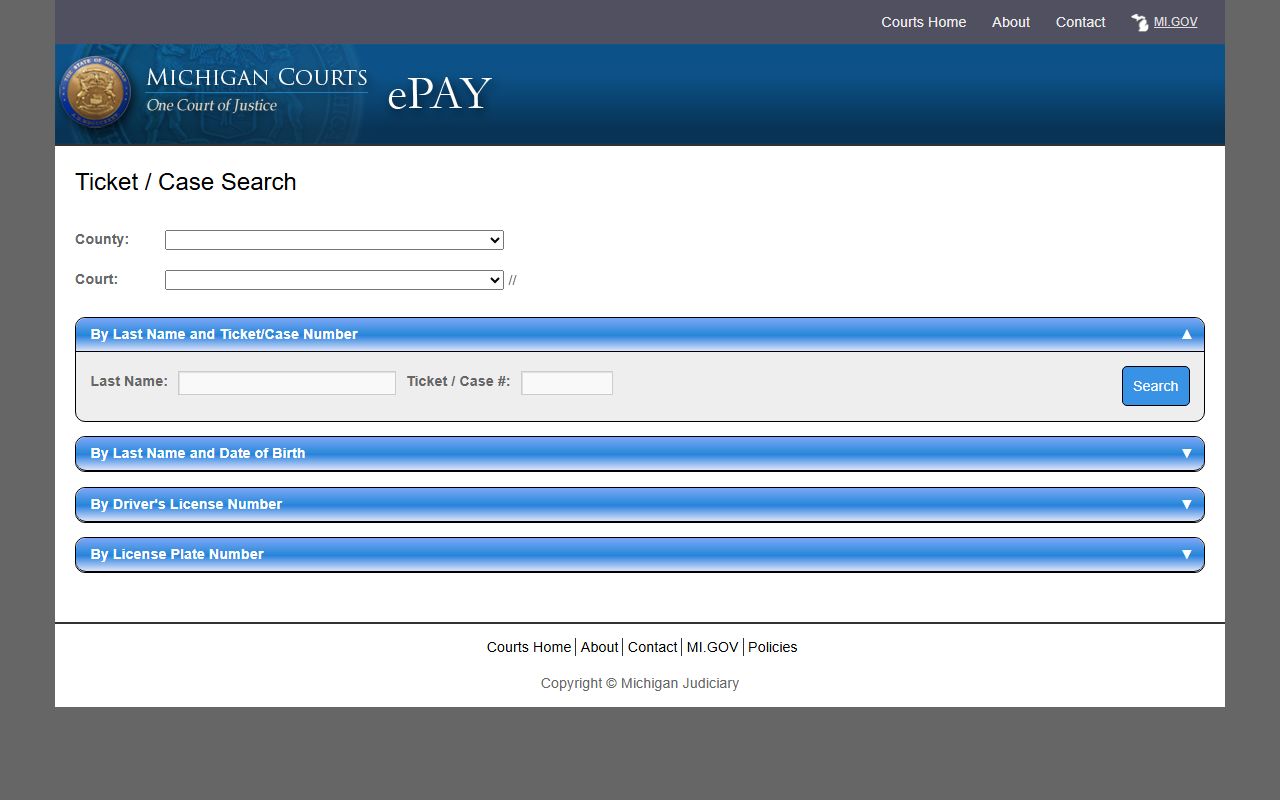
The search form asks for a county and court first, then narrows to a name or number. That order matters, because a charge attached to a Calhoun County case will not appear under the wrong court. If a ticket or charge is not listed, the portal tells you to contact the court that holds the file.
Who Files Charges After a Calhoun County Arrest
Charges after arrest are filed by the prosecutor, not the officer who made the arrest. In Calhoun County that office is led by David E. Gilbert, the elected Calhoun County Prosecuting Attorney. The office is elected to a four-year term and works apart from the Michigan Attorney General. The chief assistant prosecuting attorney is Jim Jordan. The prosecutor reviews what the police bring, weighs the proof, and then decides which counts to charge, if any. You can read the office overview and staff on the Calhoun County Prosecuting Attorney page.
The office handles felony and misdemeanor prosecution, victim services, restitution work, and diversion programs such as bad-check recovery. Victims have a real role here. The Crime Victims Unit helps people learn their rights, find support, and take part in court. Details and the restitution forms are on the crime victims unit page.
The unit page also lists impact-statement and restitution forms for both property and check or card crimes. That side of the file explains why some charge records carry victim and restitution entries. It ties the charge that a prosecutor files to the harm the case is meant to address.
How Charges Get Filed After a Calhoun County Arrest
The charge record starts with a charging document. After the arrest and booking, the prosecutor files a paper that names the counts and opens the court case. Michigan uses three main types. A complaint is common for misdemeanors and can also open a felony case. An information is the felony charging paper the prosecutor files after a district-court preliminary exam sends the case up. An indictment comes from a grand jury and is used for some serious felonies. In Calhoun County most felonies begin in the 10th District Court and move to the 37th Circuit Court after bindover.
| Complaint | Information | Indictment | |
|---|---|---|---|
| Filed By | Officer / Prosecutor | Prosecutor | Grand Jury |
| Common For | Misdemeanors | Many felonies | Serious felonies |
| Starts | The case | The case | The case |
Each of these papers turns an arrest into a formal charge that a court will track. The document lists the counts, the statute each count rests on, and the level of each offense. From there the charge takes on a status that can shift as the case moves.
Charge Status in Calhoun County Court Records
Charges do not stay fixed once they are filed. As a case moves, a count can be amended, reduced, added, dropped, or dismissed. The court record shows the current status of each charge, and reading that status is the key to knowing where a case truly stands. A charge marked pending is still open. One marked dismissed has been ended by the court. A nolle prosequi entry means the prosecutor has chosen not to press that count for now.
| Status | What It Means |
|---|---|
| Pending | The charge is filed and still open, with no final ruling yet. |
| Amended / Reduced | The charge was changed, often to a lesser count or a corrected statute. |
| Dismissed | The court ended the charge; it may be with or without prejudice. |
| Nolle Prosequi | The prosecutor formally declined to pursue that count. |
The ePAY result view offers a plain example of live charge and fine data. You can see it on the ePAY results page, where each row shows the ticket number, the name, the violation text, and the amount due. That row is a small charge record in its own right.
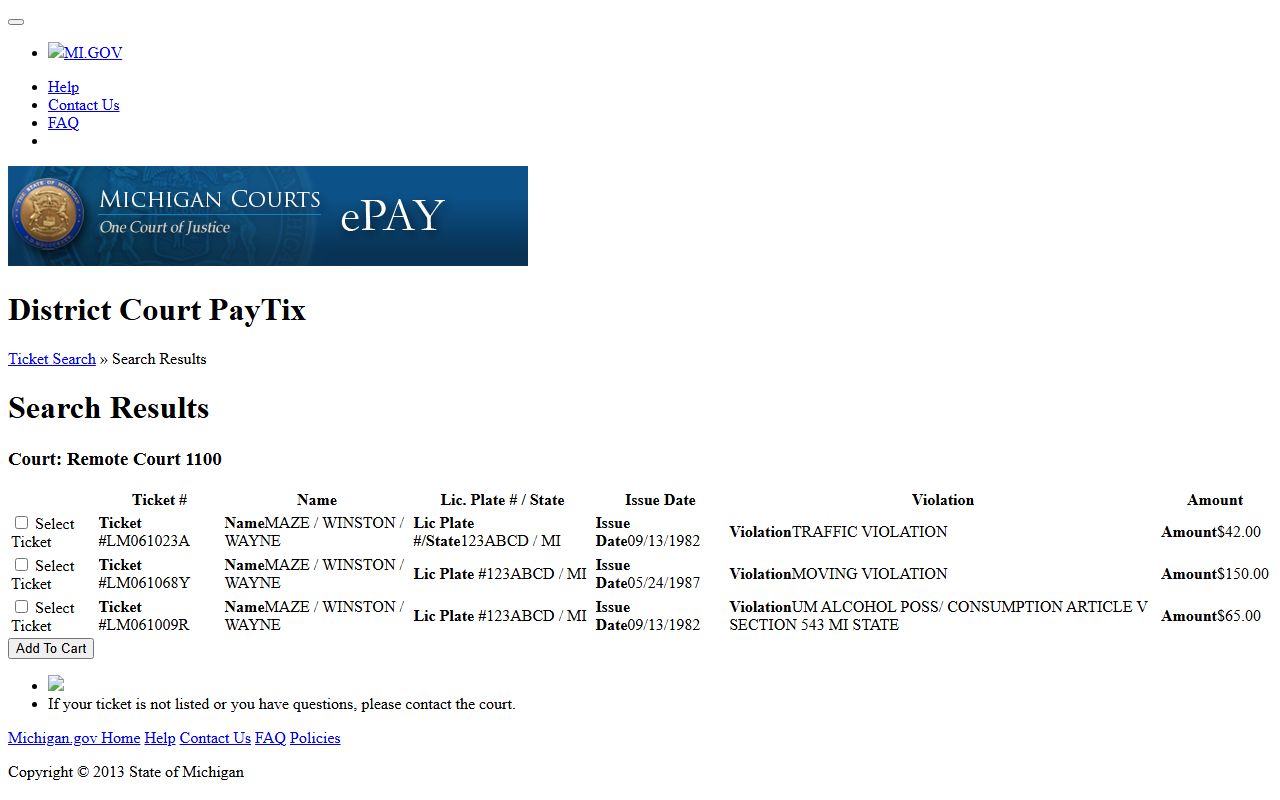
The violation text on that row is the charge, and the amount is what the count now carries. A full court case shows the same idea with more depth: several counts, each with its own code and its own status line.
Note: A dismissed or reduced charge does not erase the arrest itself, so the arrest record and the court charge record can tell two different stories.
Charge Codes and Severity in Calhoun County
Every charge is tied to a statute, and that statute sets the code and the level. Michigan sorts offenses into three broad tiers. A civil infraction is a noncriminal violation, such as most traffic tickets. A misdemeanor is a less serious crime, handled in Calhoun County by the 10th District Court. A felony is a more serious crime that moves to the 37th Circuit Court after a bindover. The level shapes the range of penalties and the court that hears the case.
One arrest can produce several separate charges. A single stop might yield one felony count, a misdemeanor count, and a civil infraction all at once. Each count gets its own code and its own status, so a case record can show a mix of levels under one case number. Reading the code next to each count tells you which statute the prosecutor relied on and how serious that count is meant to be.
Note: The charge level can change over time, so a felony filed at the start may show as a reduced misdemeanor by the time the case closes.
Charges vs. Convictions in Calhoun County
Being charged is not the same as being convicted. A charge is an accusation that the prosecutor must still prove. A conviction is the result of a plea or a verdict that finds the person guilty. Many charges never turn into convictions, because they get dropped, dismissed, or reduced along the way. The court charge record shows the charge; the disposition shows whether it became a conviction. The full case file and any sentence are covered on the Calhoun County criminal court records page.
| Charge | Conviction | |
|---|---|---|
| Stage | Accusation | Verdict or plea |
| Burden of Proof | Probable cause | Beyond reasonable doubt |
| Public Record | Yes | Yes |
Both a charge and a conviction are public court records in most cases. The difference lies in what each one proves. A charge only shows that the state accused someone. A conviction shows that the case ended in a finding of guilt, either through a plea or a trial.
Statewide Charge and Criminal History Lookups
County court files show charges filed in Calhoun County, but they are not a full criminal history. For a statewide view, Michigan offers a name-based search through ICHAT and a fingerprint-based personal records check through the Michigan State Police. The county clerk notes three ways to confirm whether a conviction has been set aside: an MSP fingerprint check for a $30 fee, an ICHAT name search for a $10 fee, or a direct check with the court of conviction. A courthouse file search covers Calhoun County felonies only and is not a criminal-history background check.
For people held by the state, the picture shifts to the Michigan Department of Corrections. Its Offender Tracking Information System, known as OTIS, is the place to look. You can search it on the OTIS offender search page by last name, first name, offender number, sex, race, or age.
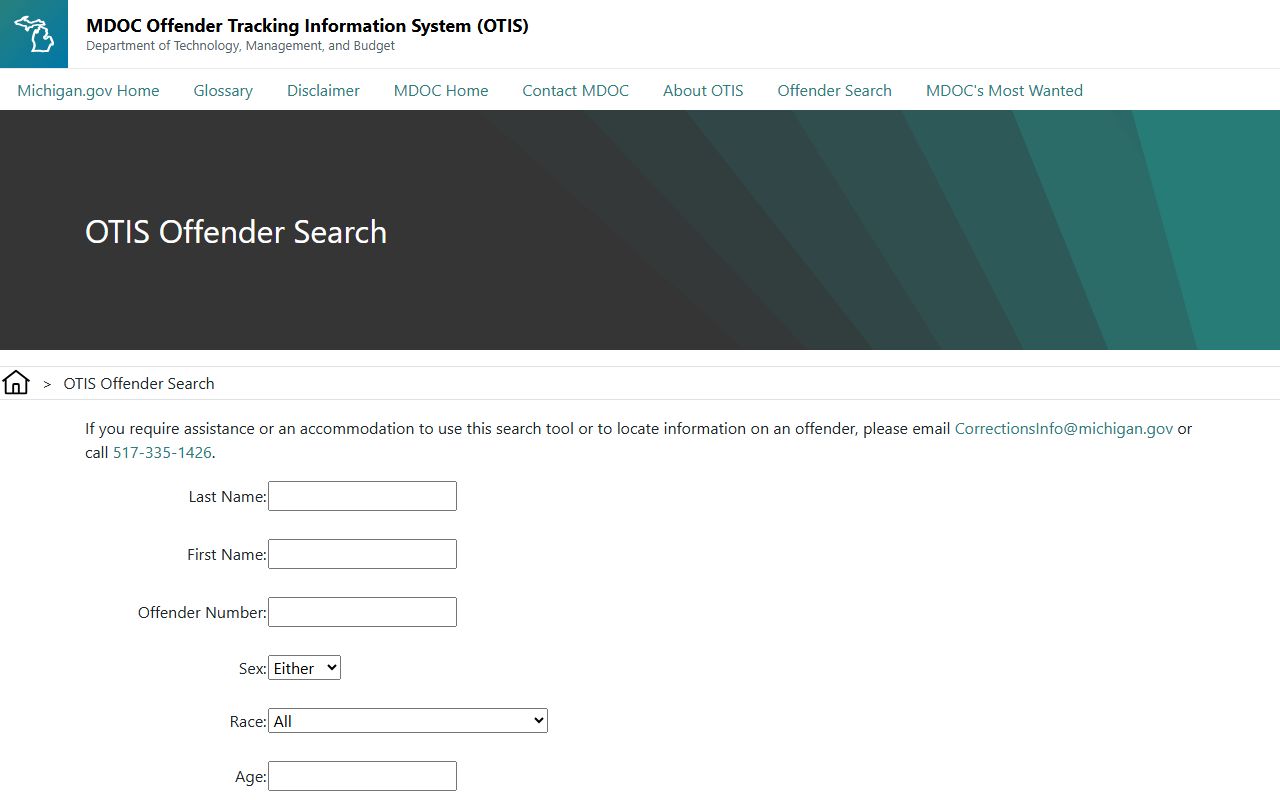
OTIS covers prisoners, parolees, and probationers under state supervision, plus people released within the last three years. That makes it the right back-up once a person leaves the county jail and enters the state prison system. The county jail roster and OTIS are separate tools that answer different custody questions.
Calhoun County Sheriff Records Division
The booking side of an arrest runs through the sheriff. The Calhoun County Sheriff, Steven Hinkley, oversees a records division that handles a wide set of public-facing requests. That office deals with FOIA requests, report copies, incarceration records, fingerprinting, pistol permits, and the booking-fee process. It is the right stop when the detail you need is about the arrest and booking rather than the court charge.
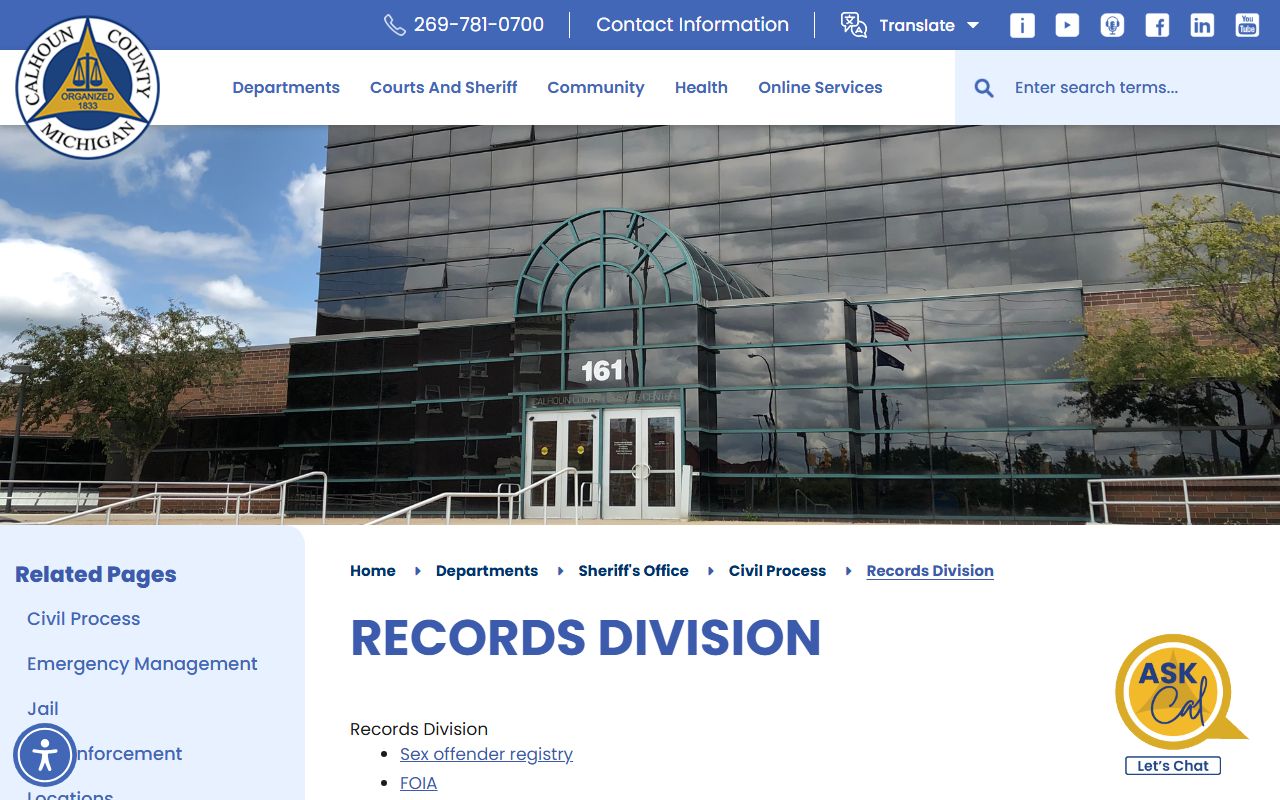
The full menu of services sits on the sheriff records division page, which spells out how to file a FOIA request and how the booking fee works. To request an incarceration record or a report, you go through this division rather than the court clerk. For a broader look at the agency, the sheriff office page lays out the department, its contacts, and its service directory.
The sheriff office overview is useful because it ties the jail, the records desk, and the public-safety functions into one hub. When an arrest record and a court charge point to different offices, this page helps a reader learn who holds which piece. The court charges stay with the prosecutor and the court; the arrest and booking stay with the sheriff.
Note: A booking charge listed at arrest can differ from the count the prosecutor later files, so check both the sheriff record and the court record.
Background Check Considerations
A casual name lookup and a formal background check are not the same. A quick search of a court portal can show open charges and case status, but it is not a screened, verified report. A regulated background check for hiring, housing, or credit must follow the federal Fair Credit Reporting Act, which sets rules for accuracy, consent, and dispute rights. Charges and convictions can read very differently once those rules apply.
Important: This site is not a consumer reporting agency under the FCRA, and its information may not be used for hiring, housing, credit, or other FCRA-regulated screening.
Sealed vs. Expunged Records
Not every charge stays public forever. Michigan lets people ask a court to set aside eligible convictions, and that changes what the public can see. A sealed record is hidden from public view but still exists for limited use. An expunged or set-aside record is treated as though it was removed from the public file. The two terms are close, but the effect on access is not identical.
| Sealed | Expunged | |
|---|---|---|
| Visibility | Hidden from public | Destroyed / treated as never existed |
| Law Enforcement | Limited access | Very limited |
| Eligibility | By court order under Michigan rules | Set-aside petition under MCL 780.621 |
Michigan's set-aside statutes control who qualifies and what the effect is once a court grants relief. The rule on the effect of a set-aside conviction sits at MCL 780.623, which limits how that record can be used. To confirm what remains public, the county points people to an MSP or ICHAT check or the court of conviction.
Restricted Charge Records in Calhoun County
Some charge records are held back from public view by law. Juvenile cases are the clearest example. The county says all juvenile matters are nonpublic, and the public dockets leave delinquency and child-protective cases off the schedule. That means the absence of a case from a public search is not proof the matter does not exist. Michigan keeps juvenile records confidential under MCL 712A.28.
Other limits apply to sealed filings, set-aside convictions, sensitive mental-health matters, and divorce complaints before proof of service is filed. Personal identifiers such as Social Security and financial-account numbers are redacted from the public record. Court access itself runs under Michigan's open-records framework and court rules, starting with the state Freedom of Information Act at MCL 15.231, which presumes access unless an exemption applies. When a charge record is not online, a written request to the office that holds it is often the next step.
Note: A charge that is dismissed or set aside may be withheld or redacted, so a public search will not always show the full arrest-to-charge history.