
How to Search Calhoun County Court Records
The search path in Calhoun County is a stack, not one box. First you pick the court that holds the file. Then you use the matching online tool. Then you call the clerk for old or offline papers. The county online-services hub links straight to circuit case search, district case search and schedule, probate case search, a jail lookup, and payment tools. That means the county trusts a shared set of state and county portals rather than one local database.
The main statewide tool is MiCOURT case search. County court pages route users into the MiCOURT public case search instead of a Calhoun-only site. The system is built statewide but filtered to Calhoun content through the court links. Before you start, have a party name or a case number ready. The clerk's staff also ask for a case number when you call, so pull it first if you have it.
- Decide which court holds the case: circuit for felonies and big civil suits, district for traffic and misdemeanors, probate for estates.
- Open MiCOURT and search by name or by case number for current circuit, district, and probate matters.
- Check the daily district calendar or circuit docket pages for hearing times and courtroom assignments.
- Contact the circuit clerk for files older than the online index, for archived files, and for certified copies.
- File a public-records request when a document is not online and the office that holds it can lawfully release it.
The county home site is the plain-English map to all of these tools. A quick look at the Calhoun County government homepage shows the top-level links to courts, the clerk, the sheriff, and current alerts.
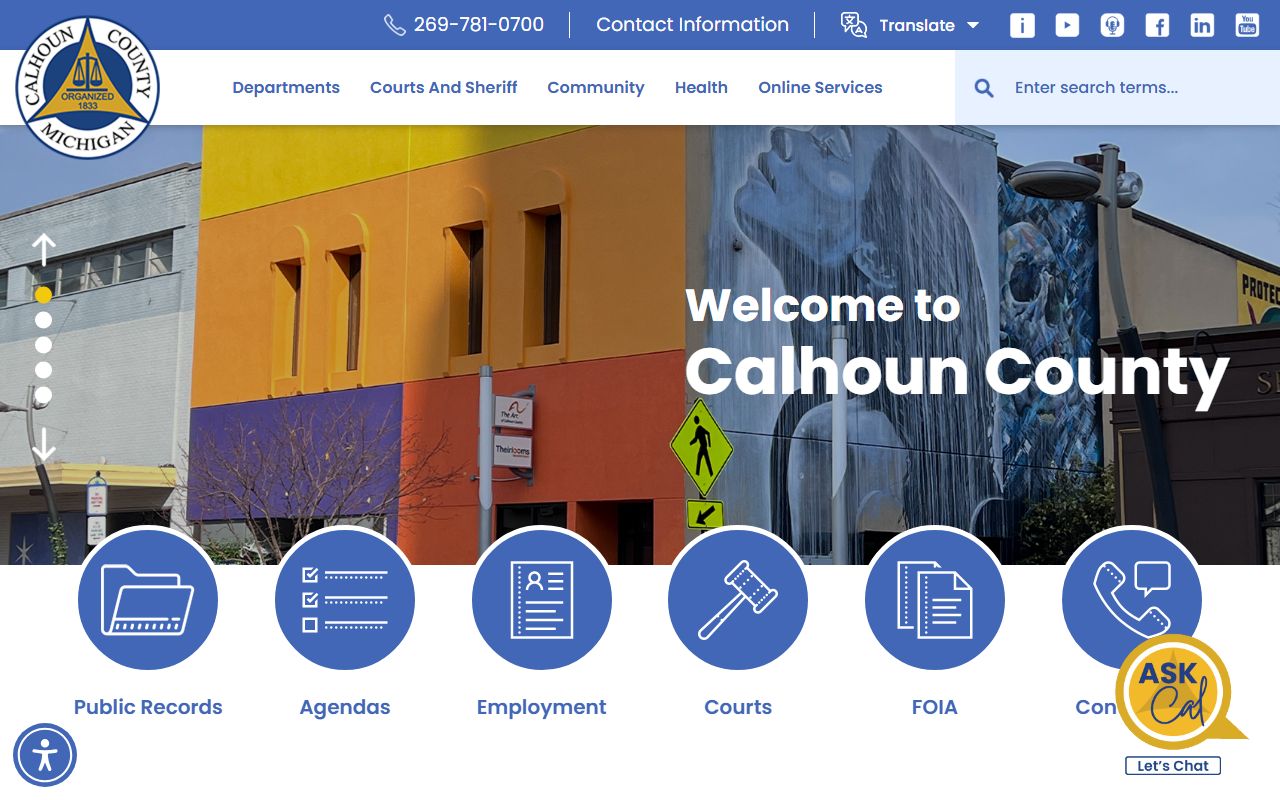
That single hub keeps the search stack in one place, which is why a Calhoun County court records search almost always starts there before it moves to a court-specific page.
Calhoun County Court Case Search Fields
The best documented public tool in the county stack is the state ePAY ticket and case portal. It is not a full case database, but it is a clear search and payment tool for traffic tickets and some payable court items. It shows exactly what fields the public can enter and what a result row returns. You can review the Michigan ePAY ticket search to see the live form.
| Field Label | Type | Required | Notes |
|---|---|---|---|
| County | dropdown | Yes | Select Calhoun County first. |
| Court | dropdown | Yes | Choose the matching court before searching. |
| Last Name | text | Yes | Used in name-based searches. |
| Ticket / Case # | text | One mode | Ticket or case number. |
| Date of Birth | date | One mode | Month, day, year. |
| Driver Lic # | text | License mode | Paired with a state selector. |
| License Plate # | text | Plate mode | Paired with a state selector. |
The result page shows the ticket number, name, plate and state, issue date, violation, and amount due. The portal tells users to contact the court if a ticket is not listed. That single line marks the edge of the tool: it does not hold every file, and the court still owns the record behind it.
Note: The MiCOURT search offers name, case number, and date filters, so pick a name search when you lack a case number and a case-number search when you have one.
The Calhoun County Court System
The county's court structure is easier to grasp if you start with the state constitution. Calhoun County's courts came from Article VI of the 1963 Michigan Constitution. That article places all judicial power in one court of justice, split into the Supreme Court, the Court of Appeals, the circuit court, the probate court, and courts of limited jurisdiction. In Calhoun County that framework runs through the 37th Circuit Court, the 10th District Court, and the Probate Court.
The circuit court is the county's main trial court. In Calhoun County it is the 37th Judicial Circuit, and that circuit covers only Calhoun County. It hears felony cases after they leave district court, civil suits, family and domestic cases, adoptions, name changes, and personal protection orders. The district court is the lower trial court. The 10th District Court takes misdemeanors, civil infractions, landlord-tenant disputes, small claims, and civil cases under $25,000. It also handles warrants, arraignments, and preliminary exams. Probate is a separate trial court, not a branch of the circuit court.
Case flow: District Court › Circuit Court › Michigan Court of Appeals (Fourth District) › Michigan Supreme Court
An appeal from a Calhoun County ruling goes to the Michigan Court of Appeals, Fourth District. All three trial courts share the same Justice Center, so the county is simple in layout even when a reader must still pick the right search tool.
| Court | Role | Phone |
|---|---|---|
| 37th Judicial Circuit Court | Felonies, civil suits, family matters, PPOs, appeals | 269-969-6518 |
| 10th District Court | Misdemeanors, traffic, civil infractions, small claims | 269-969-6666 |
| Probate Court | Estates, wills, guardianships, mental-health cases | 269-969-6794 |
Circuit, District, and Probate Courts Compared
The three trial courts handle very different work, and the split decides where a record lives. A felony charge starts in the district court but ends up in the circuit court after bindover. A small claim or a traffic ticket stays in the district court. An estate or a guardianship goes to probate. Knowing that split saves a wasted trip or a dead-end search.
| Feature | Circuit Court | District Court | Probate Court |
|---|---|---|---|
| Case types | Felonies, family, big civil | Misdemeanors, traffic, small claims | Estates, guardianships |
| Civil dollar range | Over $25,000 | Under $25,000 | Estate value based |
| Criminal role | Felony trials after bindover | Early stages and misdemeanors | Mental-health proceedings |
| Circuit number | 37th | 10th | County probate |
All adult criminal cases start in the district court even when they later move up. That is the practical answer to the common question, "where is my criminal case?" Expect the district court to show the early steps and the circuit court to hold the fuller felony file.
Types of Court Records Available in Calhoun County
Calhoun County's record set splits by court and by subject. The circuit clerk holds felony, civil, domestic, family, and personal-protection files. The district court holds traffic, civil-infraction, misdemeanor, and small-dollar civil files. Probate holds estates, guardianships, conservatorships, and mental-health matters. The clerk's vital-records office handles marriage licenses and certified copies, while the sheriff's office keeps custody and booking data.
Each record type answers a different need, and each one has its own front door in the county system. The most common categories are these:
- Criminal records - felony files in circuit court and misdemeanor files in district court, with arraignment, plea, and sentencing papers.
- Civil records - lawsuits, judgments, evictions, and small claims, split by dollar amount between the two trial courts.
- Family records - divorce, custody, support, paternity, and personal protection orders in circuit court.
- Probate records - wills, estates, trusts, guardianships, and conservatorships.
- Traffic records - civil infractions, misdemeanor traffic offenses, and city ordinance violations in district court.
Juvenile files sit apart. Delinquency, neglect, abuse, and adoption cases are handled through the family process and do not appear on public schedules, which is why a missing case on a docket is not proof a matter never existed.
What Calhoun County Court Records Show
A Michigan court record is defined broadly. It is not a single PDF. It can hold pleadings, orders, judgments, case-management entries, notices, and process issued by the court. The county's daily dockets and case-search tools show a slice of that file, not always the full paper stack. Still, the visible fields are enough to identify a case and track its path.
| Field | What It Shows |
|---|---|
| Case Number | The court and year prefix, such as a 2026 case with a DC court suffix. |
| Party Name | The person or entity in the case. |
| Filing Date | When the case opened. |
| Case Type | Criminal, civil, family, probate, or traffic. |
| Hearing Date | Scheduled time and courtroom. |
| Disposition | Current status or final outcome. |
| Balance Due | Fines, fees, or amounts owed. |
The district calendar proves the shape of a public docket. It lists party name, hearing time, hearing title, courtroom, and case number. A sample line shows a case number that reads with a year prefix and a court-type suffix, so a reader can tell at a glance that the file is county and court specific. Protected data such as Social Security numbers, financial-account numbers, and minor names stay hidden from the public view.
Public Access Laws for Calhoun County Court Records
Michigan gives Calhoun County readers three access routes. The Freedom of Information Act covers county-office records. Court rules cover court files. A few targeted statutes lock down juvenile and set-aside records. The county pages tell users where to go first, and these statutes explain why an office can or cannot hand over a file. Court records sit under MCR 8.119 and the Chapter 8 court rules rather than under FOIA alone.
Key Statutes:
Michigan Compiled Laws § 15.231 - The state FOIA starts with a presumption that public records are open unless an exemption applies.
Michigan Compiled Laws § 15.233 - A requester may inspect or copy a public record unless another law blocks it.
Michigan Compiled Laws § 15.243 - Some personal and law-enforcement material can be withheld under listed exemptions.
Michigan Compiled Laws § 552.6a - A divorce complaint is not open to the public until proof of service is on file.
Michigan Compiled Laws § 712A.28 - Juvenile case records are not generally public.
The practical order for any Calhoun County record is steady. Use the right online portal first. Then contact the office that holds the file. Then use the clerk or sheriff records desk for older or offline files. Use FOIA for county-office material that is not a court file.
Records That Are Restricted or Confidential
Calhoun County spells out its privacy limits in a usable way. Juvenile cases are the clearest example. The circuit clerk says all juvenile cases are nonpublic and that staff will ask for identification when someone discusses or requests those documents. Public schedules leave out delinquency and child-protection matters, so their absence on a docket means nothing about whether a case exists.
Other categories stay limited too. Adoption files run through the family process with tight access. Mental-health proceedings are limited-access probate matters. Sealed cases stay closed until a judge unseals them. Divorce complaints are shut before proof of service. Personal identifiers are redacted from every public view.
Expungement is the most common practical question. The circuit clerk points readers to the Clean Slate process and lists three ways to check whether a conviction has been set aside: a Michigan State Police fingerprint check for a $30 fee, an ICHAT name search for a $10 fee, or a check with the court of conviction. A courthouse file search is not a criminal-history background check, and the county says so plainly.
Specialty Courts in Calhoun County
Calhoun County runs three problem-solving courts on the district-court side. Each one pairs a judge with a treatment team, a review schedule, and confidential staffing talks. These are not separate standalone courts; they are supervised programs inside the 10th District Court. You can read the mission and eligibility for the Calhoun County Sobriety Court on the county site.
Sobriety Court treats alcohol and drug dependence as a disease and works to cut drunk and drugged driving through education, intense treatment, and strict supervision. It is a four-phase program, and advancement depends on compliance and days sober. Veterans Treatment Court serves veterans whose service-related health or behavior issues fed into criminal conduct, and it pairs each person with a mentor who is an active or veteran member of the Armed Forces. Mental Health Treatment Court is a three-phase program for people with severe mental illness, a developmental disability, or a co-occurring substance disorder.
Note: All three specialty courts protect participant privacy, so their team discussions and staffing meetings stay confidential and do not appear in the public docket.
Calhoun County Sheriff and Jail Records
The Calhoun County Correctional Facility opened in 1994 as a direct-supervision jail. It is rated for 630 inmates and detainees, staffed by about 120 people, and runs a local population that averages 275 to 325. The county rents remaining beds to other cities, counties, and the federal government. The jail provides secure lodging, court security, prisoner transport, medical care, food service, and GED education. The sheriff's office also acts as a public record hub for booking data, incarceration records, and report copies.
The current public roster is the Police to Citizen inmate catalog. You can open the Calhoun County inmate catalog to see live rows that show name, age, gender, race, height, weight, arrest date, court date, expected release, primary charge, and booking agency. That structured snapshot is why the roster is a current-custody tool, not a full criminal-history source. For the full roster walkthrough and booking detail, see the county inmate records page, and for turn-in guidance check the warrant records page.
State prison custody is a separate system. Once a person leaves the county jail and enters the Michigan Department of Corrections, the right tool is the state OTIS offender search. OTIS covers prisoners, parolees, and probationers under state supervision or released within the last three years.
Marriage, Divorce, and Probate Records in Calhoun County
Marriage and divorce split across two offices. The County Clerk and Register of Deeds office in Marshall issues marriage licenses and certified marriage copies. Divorce cases are filed and tracked through the 37th Circuit Court clerk in Battle Creek, because a divorce complaint is a court record and not a vital record. Probate keeps its own venue for wills, estates, trusts, guardianships, and conservatorships. A divorce complaint stays sealed until proof of service is filed.
Marriage license rules are timed and specific. Both applicants should apply in person, both must be at least 18, and both bring a photo ID, a birth certificate, and a Social Security number. The license is valid for 33 days and carries a 3-day waiting period unless waived for a fee. Probate files can include a petition, a will, an appointment order, an inventory, creditor notices, and final accountings.
- Testator
- The person who made the will being probated.
- Executor
- The person named to carry out the terms of a will.
- Conservator
- A person the court appoints to manage another person's money or property.
Calhoun County Court Records Fees
Copy and search fees come from the clerk's office, and the county publishes them clearly. Cases from 1984 to today can be found and bought in person or by email if you include the case number and the known parties. Without a case number, the clerk charges a name-search fee. Older files carry an archival lookup fee because they sit on microfilm. You can confirm the current rules on the Calhoun County circuit court clerk page.
| Item | Amount |
|---|---|
| Copy per page | $1 |
| Certification fee | $10 |
| Case-search fee per name | $5 |
| Archival name-lookup fee (1948-1983) | $10 |
| ICHAT name search (set-aside check) | $10 |
| MSP fingerprint records check | $30 |
Files from 1947 and older are no longer at the clerk's office. The clerk does a lookup, and the requester takes that result to the WMU Zhang Legacy Collections Center to find the actual materials. That cutoff is the hard edge for the county's oldest circuit files.
Note: Certified copies bought by email are still mailed, not emailed, so plan for delivery time when a court or agency needs a sealed original.
Calhoun County Courthouse Location
The central courthouse is the Calhoun County Justice Center in downtown Battle Creek. All three trial courts share the four-floor building, with court and hearing rooms on every floor. The building is open to the public on weekdays, and the county treats the entire structure as the courthouse under the state court rules. Court administration offices sit on three of the four floors.
Entry rules are firm. No weapons or cutting instruments come inside. Cell phones and electronic devices must be silent and stored away before you enter a court or hearing room, and no device may be used or visible in a courtroom without the judge's permission. Many hearings still run over Zoom even when the building is open, so check the notice of hearing before you drive downtown. The county general-information page tracks the courthouse timeline and building history; you can review the Calhoun County general information page for that background.
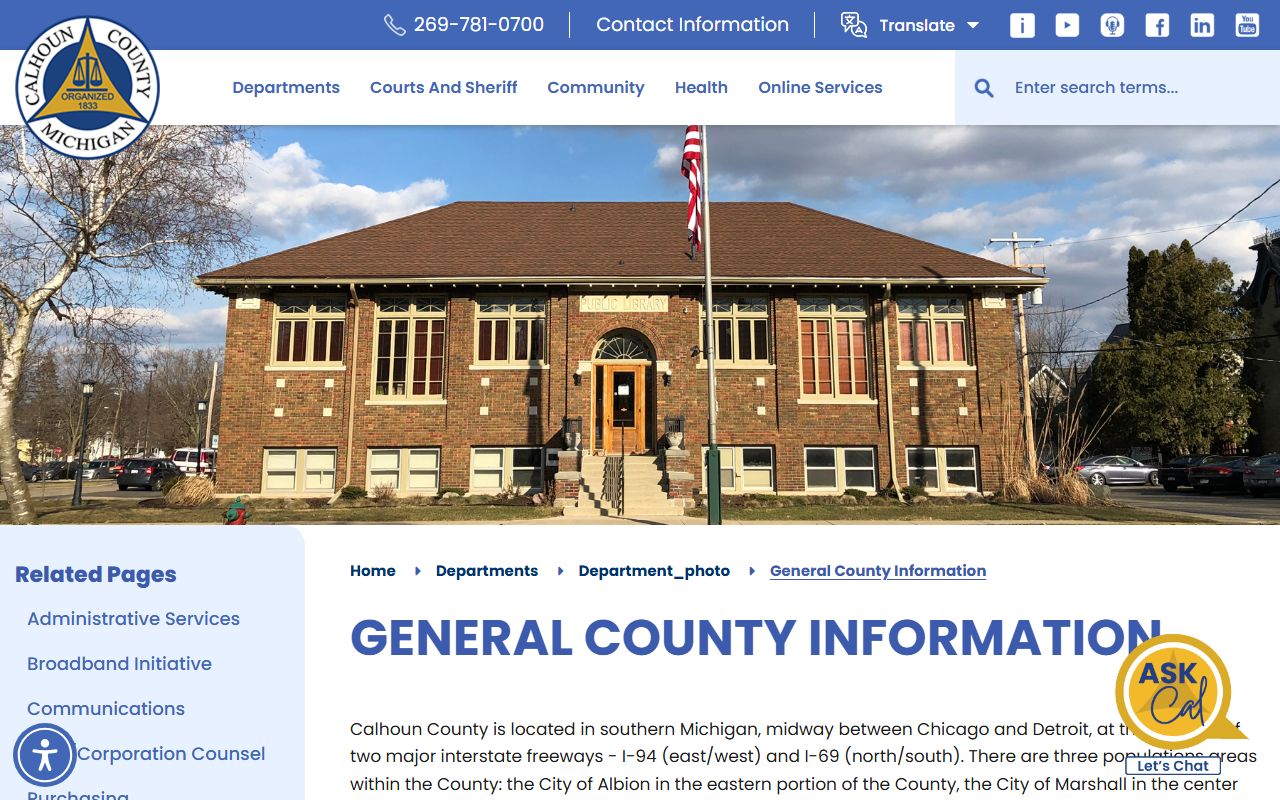
That page confirms the Justice Center is the active civic anchor for the county's court records, not a dormant historic shell.
Calhoun County Justice Center
161 E. Michigan Ave.
Battle Creek, MI 49014-4066
269-969-6350
Public hours: 8 a.m.-noon, 1-5 p.m.
History of Calhoun County Courts
Calhoun County has a rich court history on its own records. The 37th Judicial Circuit was created by Public Act 40 of 1901, effective April 4, 1901, and it began with a single judge. The bench grew over the century: a second judgeship arrived in 1950, a third in 1977, and a fourth in 1993. That growth is why the county now runs a four-judge circuit bench instead of the one-judge circuit it started with.
The courthouse itself has been rebuilt several times. The first cornerstone was laid in 1837, and the first courthouse was done in 1838. A new courthouse followed in 1875, the present County Building went up in 1955, and the Justice Center was dedicated on June 22, 1994. Calhoun County is also a cabinet county, named for John C. Calhoun during the Toledo War era, and changing that name would take state legislation rather than a local vote. The naming page tells that story in full.
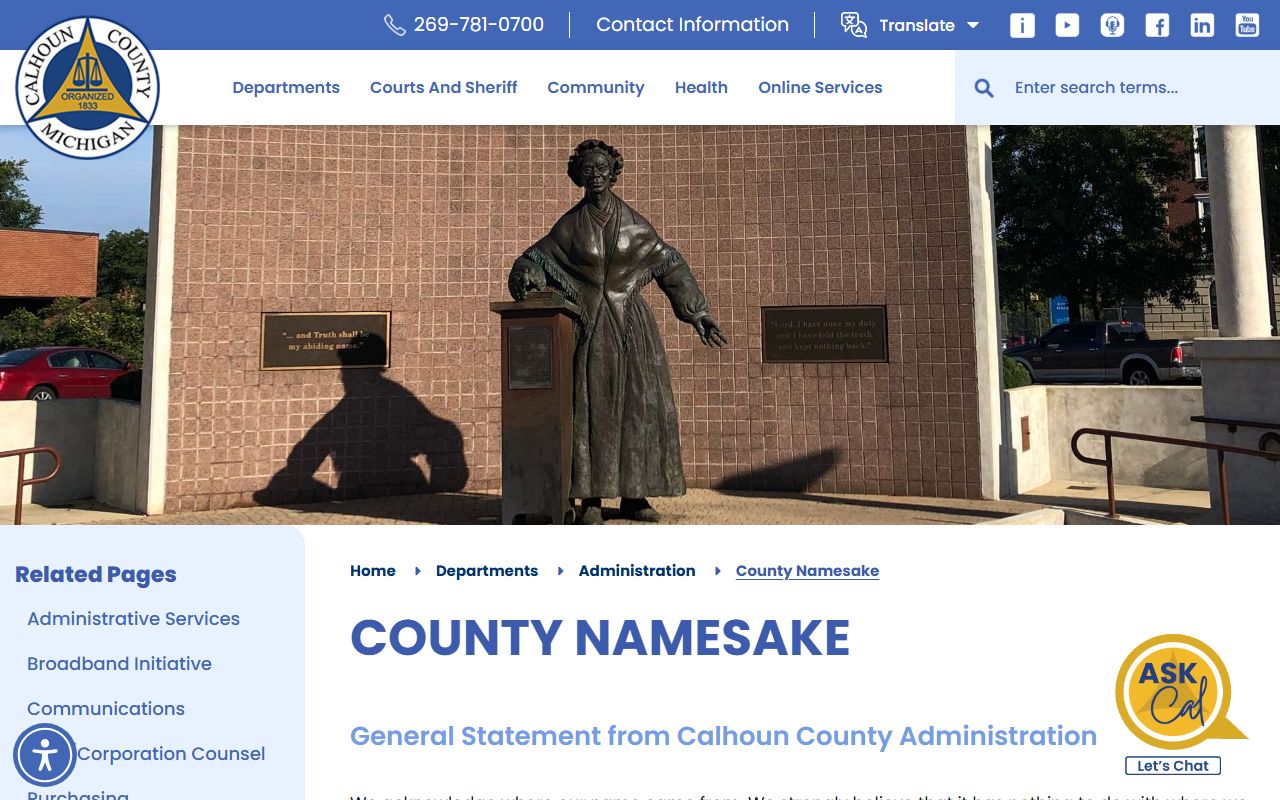
You can read the full cabinet-county explanation on the Calhoun County namesake page, which ties the county's name to a living civic debate rather than a dead plaque.
Recent Calhoun County Court Updates
The county keeps an active news feed with court, clerk, and sheriff items, which makes it easy to confirm current service changes before a visit. Recent posts show the Michigan Supreme Court re-appointing Calhoun County judges, the 37th Circuit Court marking Adoption Day, and the Clerk and Register of Deeds adding fingerprinting for new concealed pistol license applicants. A separate proposal would rename the Justice Center in honor of Mary S. Coleman, with a public hearing set for 2026.

You can scan the dated items on the Calhoun County news feed to catch holiday hours, scam alerts tied to the property-alert portal, and other records-relevant notices. Those posts are the fastest way to spot a change in courthouse hours before you make the trip.
Frequently Asked Questions
How do I search for Calhoun County Court cases online?
Start by picking the court. Circuit files, district files, and probate files all appear through the statewide MiCOURT case search, and the county court pages link straight into it. Search by party name or by case number. For daily hearing times, use the district calendar or circuit docket pages. For older or archived files, call the circuit clerk with a case number ready.
Which court handles felony cases in Calhoun County?
Felony cases start in the 10th District Court for arraignment and the preliminary exam. After bindover, they move to the 37th Circuit Court, which holds the fuller felony file, the trial, and sentencing. That is why a serious case can appear in both courts, with the early steps in district court and the later record in circuit court.
Are Calhoun County court records public?
Most are. Michigan law starts with a presumption of access under FOIA, and court files follow the Chapter 8 court rules. Juvenile cases, sealed cases, and set-aside convictions stay restricted. Divorce complaints are closed until proof of service is filed. Personal identifiers like Social Security numbers are redacted from every public record.
How much does a copy of a court record cost?
The clerk charges $1 per page and $10 to certify a document. A name search without a case number is $5, and an archival lookup for microfilm files from 1948 to 1983 is $10. Files from 1947 and earlier are held off-site at the WMU Zhang Legacy Collections Center after a clerk lookup.
Where do I check for an active warrant?
Calhoun County does not post a broad public warrant list. If you think there may be a warrant, contact the correct court to arrange a turn-in. The circuit court, district court, Friend of the Court, and Judicial Enforcement each have direct lines. The Police to Citizen portal also carries wanted-person modules for a public web check.
How do I look up someone in the county jail?
Use the Police to Citizen inmate catalog for current county custody. It shows name, age, charges, arrest date, and expected release. Once a person moves to state prison, switch to the Michigan OTIS offender search, which covers prisoners, parolees, and probationers under state supervision or released within the last three years.